Clearing the View: The Muzzle Vision Theory
While cognitive processing explains the mental trigger of the head tilt, anatomical factors often dictate the physical movement itself. Dr. Stanley Coren, a professor emeritus of psychology at the University of British Columbia and a renowned expert on canine behavior, proposed a highly compelling theory regarding dog vision and facial structure.
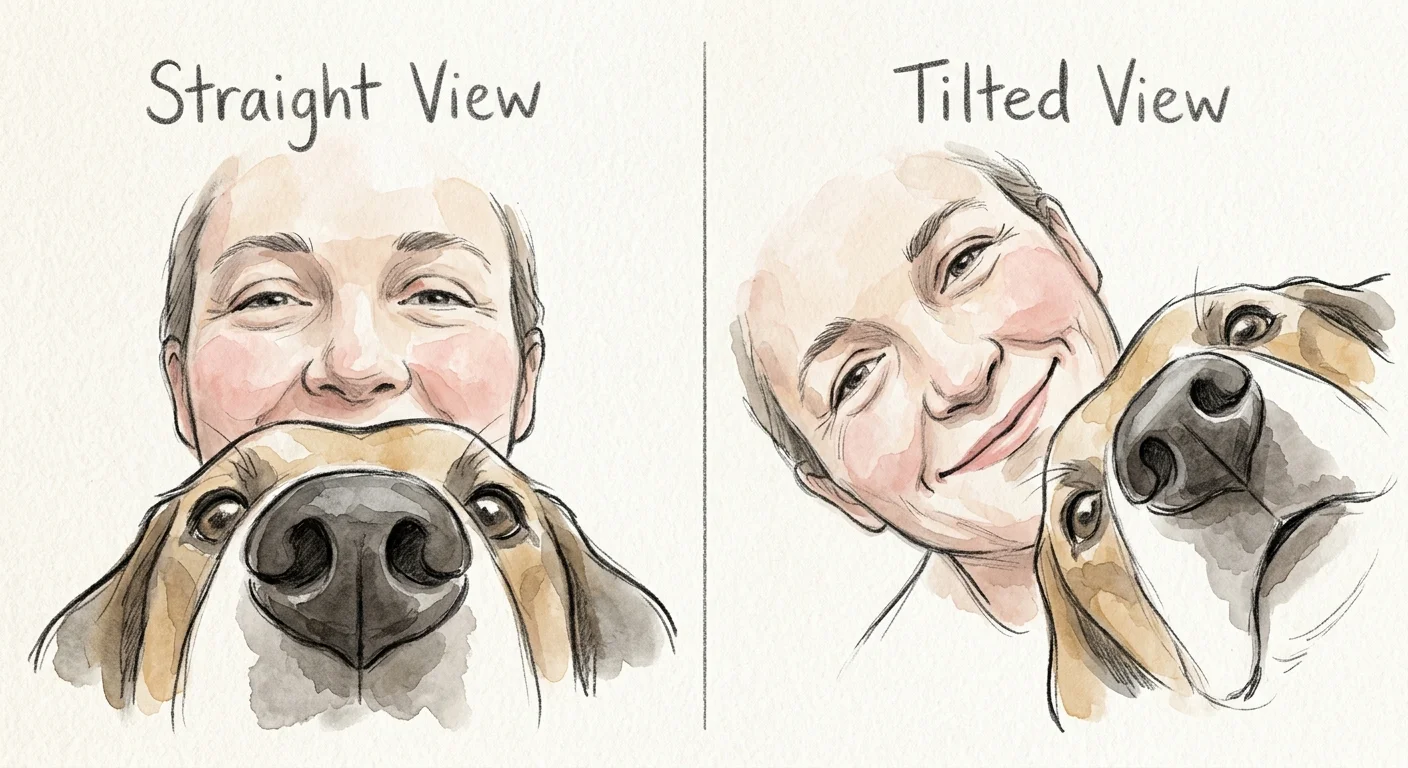
Dogs possess excellent peripheral vision, allowing them to detect motion across a wide landscape. However, their forward-facing binocular vision is partially obstructed by their own anatomy. A dog’s muzzle acts as a persistent visual barrier, blocking the lower central portion of their forward field of view. Because dogs rely heavily on reading human facial expressions to gauge emotional states, gather context clues, and interpret intentions, this anatomical blind spot creates a significant communication hurdle. When you speak, your dog actively wants to monitor your mouth to read your micro-expressions.
To fully understand this visual obstruction, Coren suggests a simple physical exercise. Make a fist with your hand, hold it thumb-side up, and place it directly against your nose. When you look forward, you will instantly notice that your fist obscures the lower half of your vision, making it incredibly difficult to see the mouth and chin of a person standing directly in front of you. If you tilt your head slightly to the left or right, your line of sight instantly clears around the obstruction, allowing you to view the person’s entire face.
In a detailed survey published in Psychology Today, Dr. Coren put this theory to the test. He gathered data from 582 dog owners and categorized their pets by skull shape. He separated the dogs into two primary groups: brachycephalic dogs with flat faces (such as pugs, French bulldogs, and Boston terriers) and dogs with pronounced muzzles (such as greyhounds, German shepherds, and golden retrievers).
The survey results demonstrated a clear statistical trend. Among the owners of long-muzzled dogs, 71 percent reported that their pets frequently tilted their heads when spoken to. For owners of flat-faced brachycephalic dogs, only 52 percent reported frequent head-tilting. While flat-faced dogs still tilt their heads—indicating that visual obstruction is not the only cause—the significant gap in frequency strongly supports the idea that long-snouted dogs use the tilt to improve their line of sight. They tilt their heads to physically see the words coming out of your mouth.