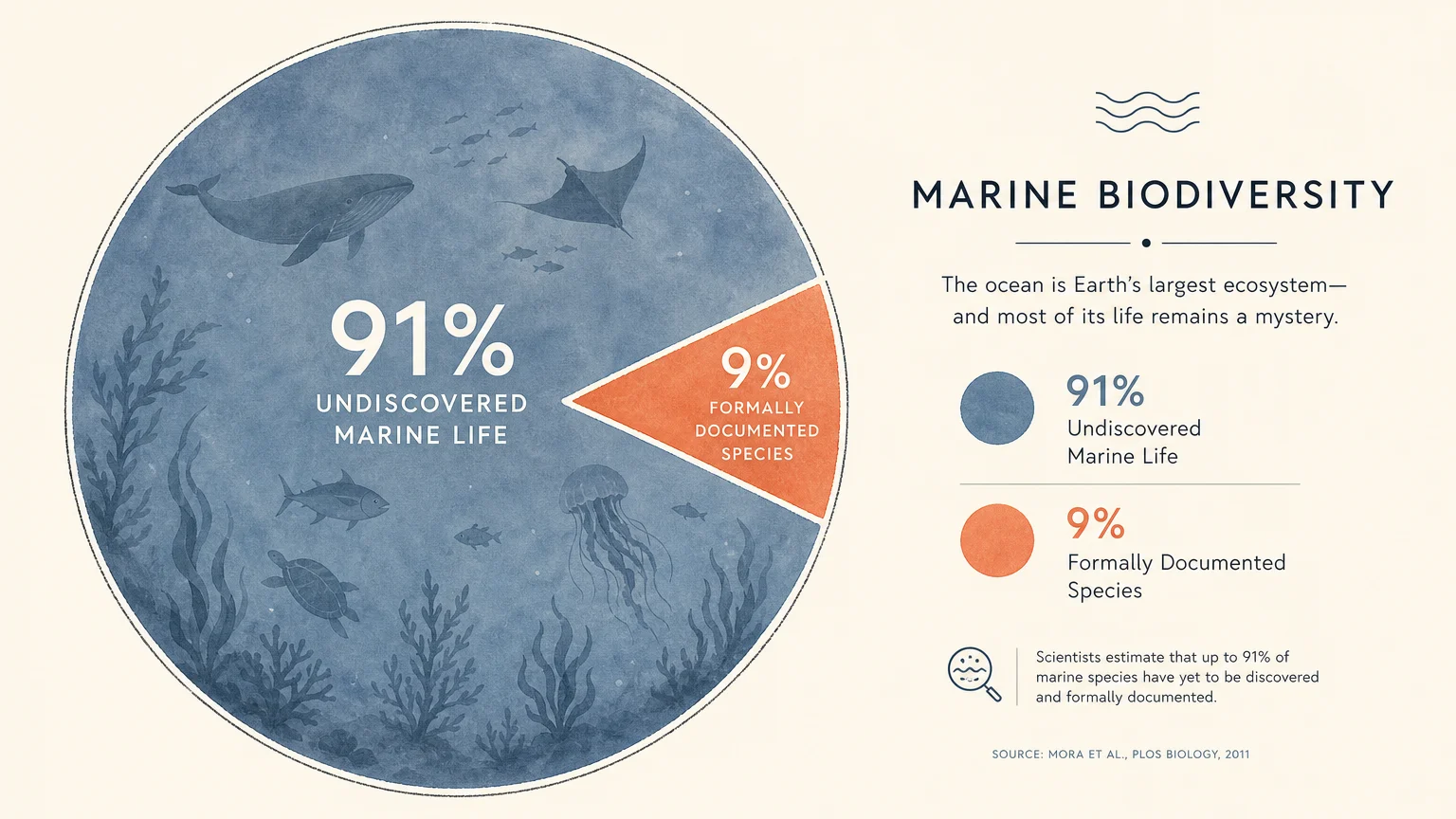
While household pets dominate our attention, the most fascinating creatures on Earth are hiding in remote forests or deep below the ocean’s surface. You do not have to travel to another planet to find aliens—our natural world is full of them. From deep-sea fish with see-through heads to tiny, venom-stealing sea slugs, bizarre adaptations allow these rare animals to thrive in extreme environments. Although the scientific community has formally documented millions of species, experts estimate that up to 91 percent of marine life remains entirely undiscovered. If you are curious about the wild fringes of nature, these five strange animals prove that evolution has a brilliant, and sometimes ruthless, sense of humor.
The Deep-Sea Marvel: The Barreleye Fish
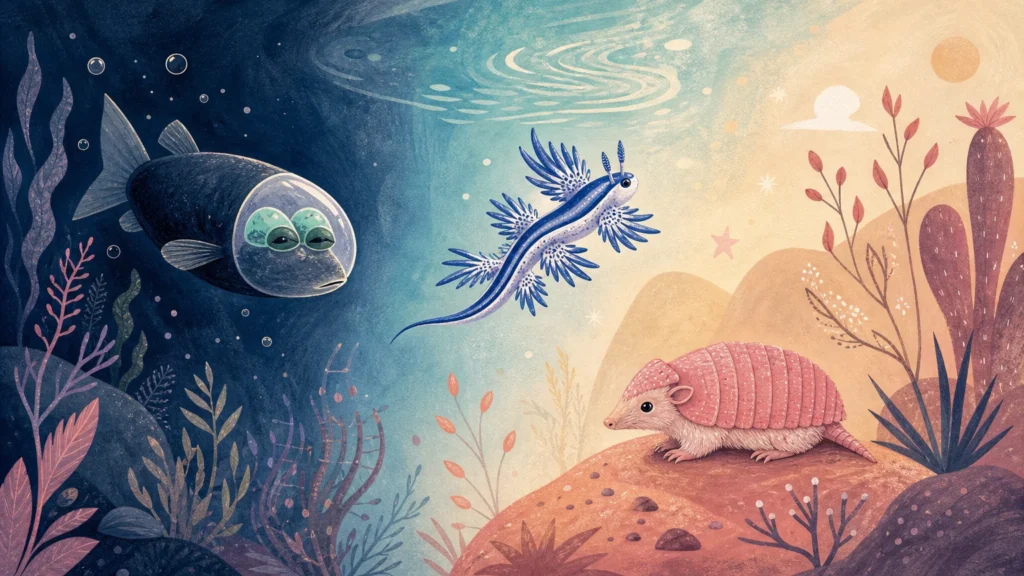
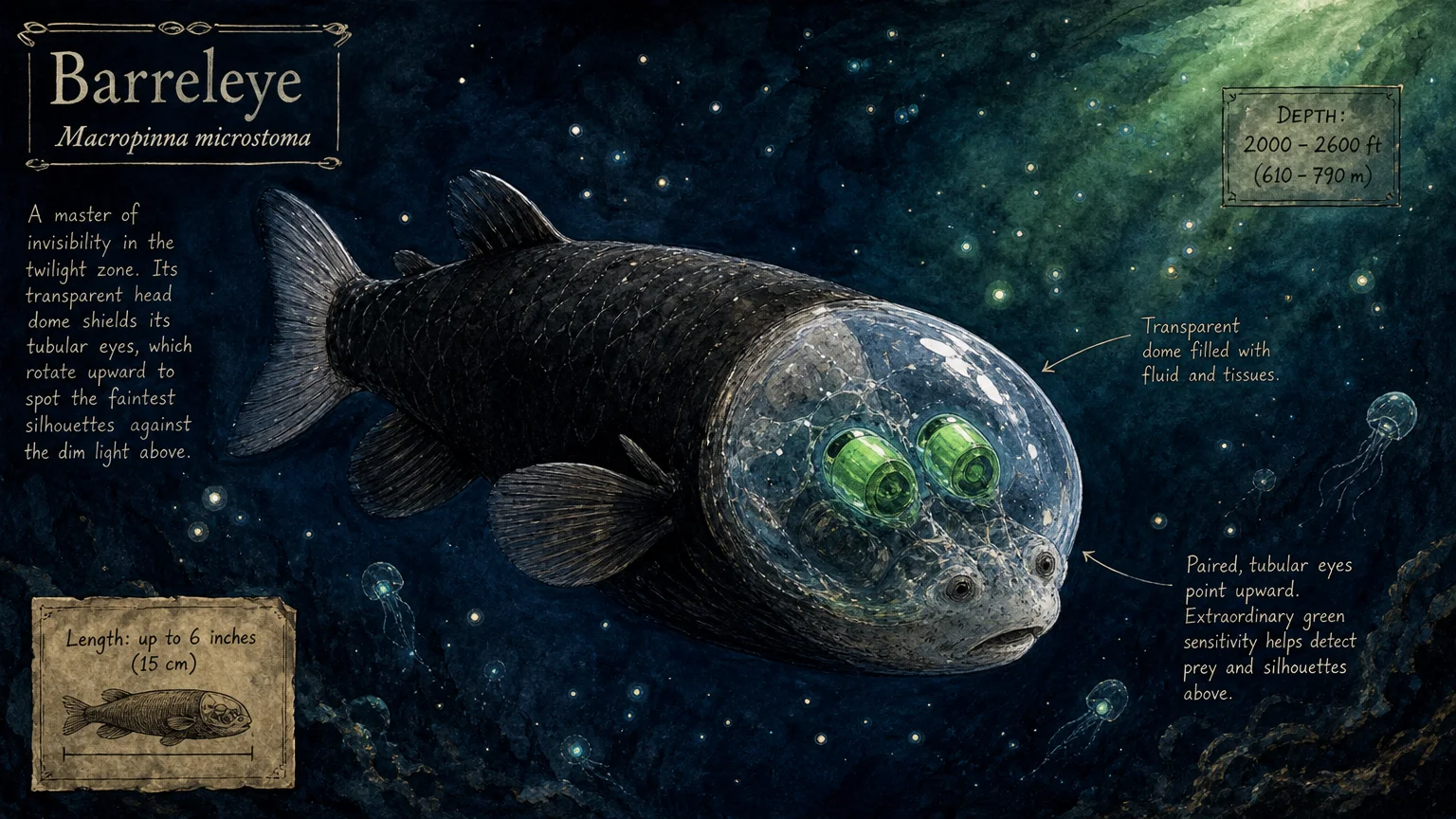
The twilight zone of the ocean is a harsh, high-pressure environment located between 2,000 and 2,600 feet below the surface. To survive in near-total darkness, the barreleye fish (Macropinna microstoma) evolved one of the most astonishing anatomical features in the animal kingdom: a completely transparent, fluid-filled head. Measuring roughly six inches long, this deep-water dweller prowls the North Pacific Ocean with two bright green, tubular eyes encased inside its clear skull.
For decades, biologists believed the barreleye’s eyes were fixed staring straight up. Looking upward allows the fish to spot the faint silhouettes of jellyfish and siphonophores against the dim sunlight filtering down from the surface. The bright green lenses act as built-in sunglasses, filtering out residual sunlight and making it easier to see the bioluminescent glow of its prey.
In 2009, researchers from the Monterey Bay Aquarium Research Institute finally captured high-definition footage of a live specimen. They discovered that the barreleye can actually rotate its eyes forward within its transparent shield. This unique mechanism allows the fish to zero in on the tiny zooplankton trapped in jellyfish tentacles, maneuvering carefully while its clear, fluid-filled dome protects its eyes from venomous stings.
The Venom-Stealing Nudibranch: The Blue Dragon
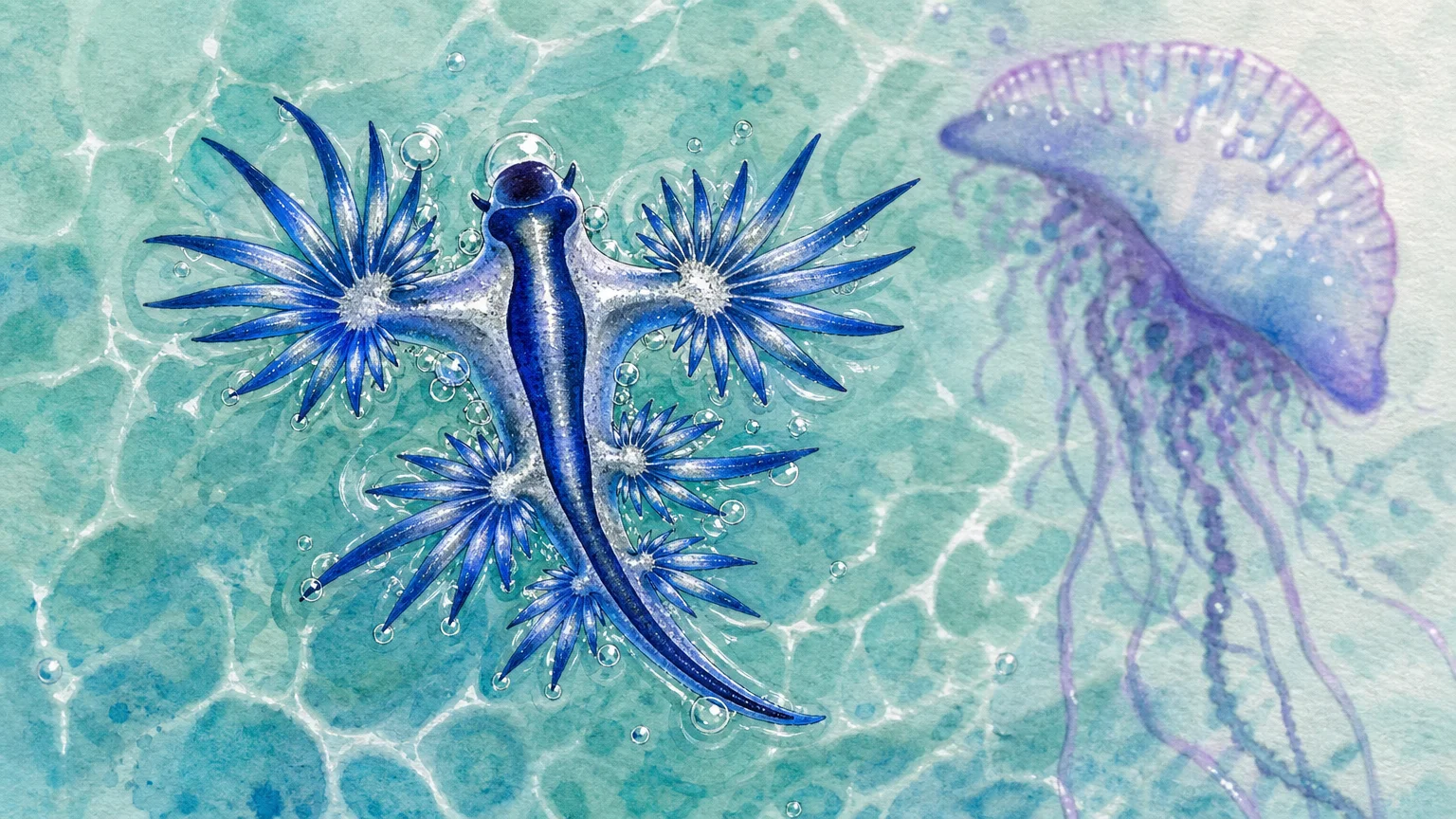
If you spot a vibrant blue and silver creature floating on the ocean’s surface, you might assume it is a harmless piece of sea glass. In reality, Glaucus atlanticus—commonly known as the blue dragon—is a highly specialized, venom-stealing predator. This pelagic nudibranch (a type of shell-less marine slug) measures just over an inch long, yet it regularly hunts and consumes the notorious Portuguese man o’ war.
The blue dragon lives its entire life in the open ocean. It swallows a small air bubble into its stomach to keep itself afloat upside down, using the water’s surface tension to ride the warm currents of the Atlantic, Pacific, and Indian Oceans. When it encounters a venomous meal, the sea slug uses sharp, serrated teeth to tear into the prey’s tentacles. Remarkably, it consumes the stinging cells—known as nematocysts—without triggering them.
The blue dragon then passes these unexploded cells through its digestive tract and stores them at the tips of its cerata, the finger-like, wing-shaped appendages extending from its body. By concentrating the stolen venom, the blue dragon packs a defensive sting that can be significantly more painful than the creature it originally ate. It is a stunning display of taking an enemy’s weapon and upgrading it for personal use.
The Desert Ghost: The Pink Fairy Armadillo
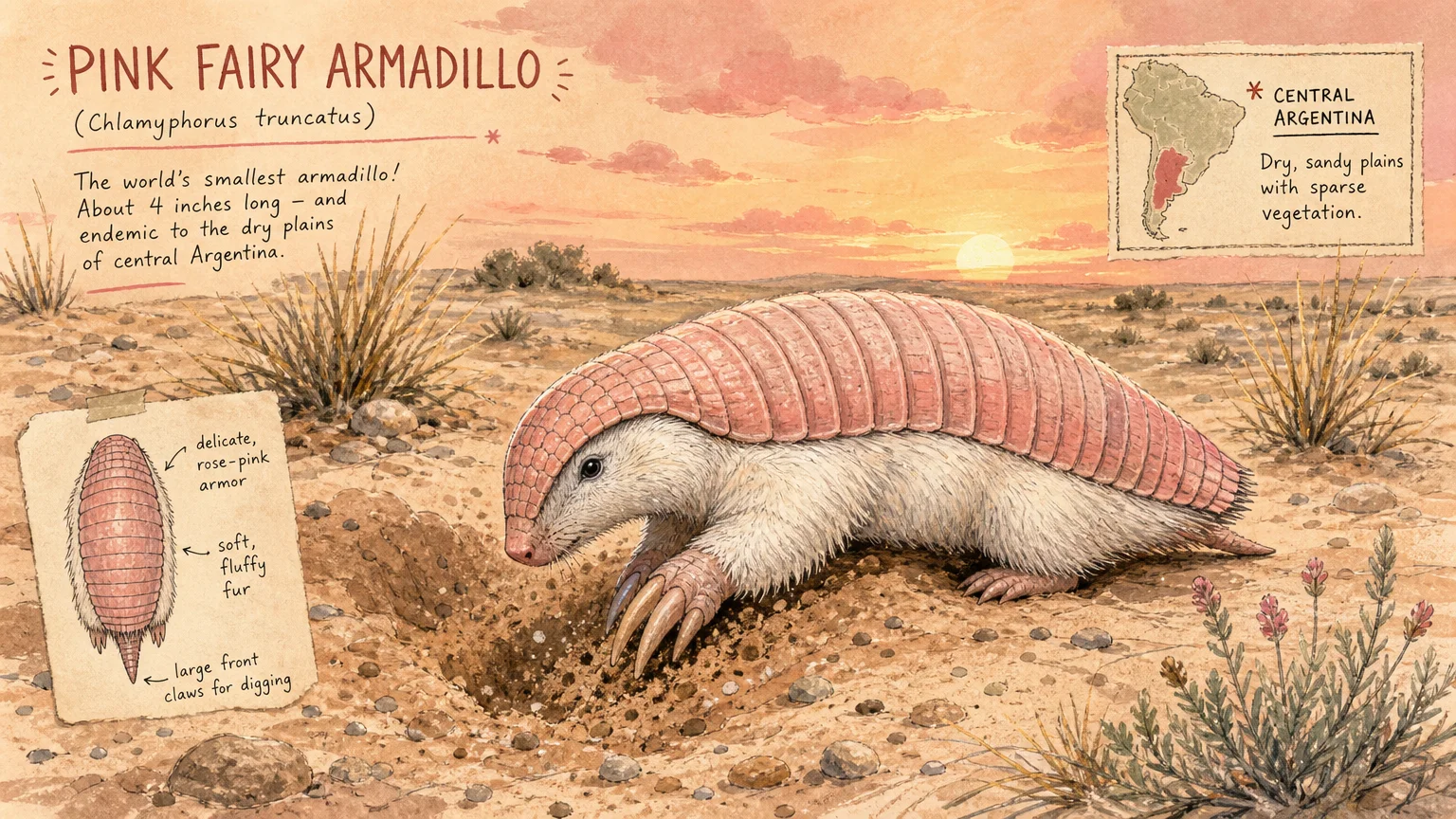
Most armadillos rely on heavy, gray armor plates to fend off predators, but the pink fairy armadillo (Chlamyphorus truncatus) takes a completely different survival approach. Measuring just 3.5 to 4.5 inches long and weighing barely four ounces, it is the smallest armadillo species on Earth. Native exclusively to the dry, sandy plains and scrublands of central Argentina, this elusive mammal spends almost its entire life underground.
Using its massive front claws, the pink fairy armadillo navigates loose sand like a swimmer moving through water. As it rapidly digs, it uses a flat, diamond-shaped plate on its rear to pack the dirt behind it, preventing its elaborate tunnel systems from collapsing.
Its most striking feature is its rosy pink shell, which is attached to the body only along the spine by a thin dorsal membrane. This flexible armor acts as a built-in thermostat. Because the armadillo has a very low metabolic rate, it struggles to regulate its internal temperature. The shell contains a dense network of blood vessels; by pumping blood into the shell, the armadillo can release excess body heat into the surrounding soil, giving the shell its distinctive pink color.
The Forest Phantom: The Great Potoo
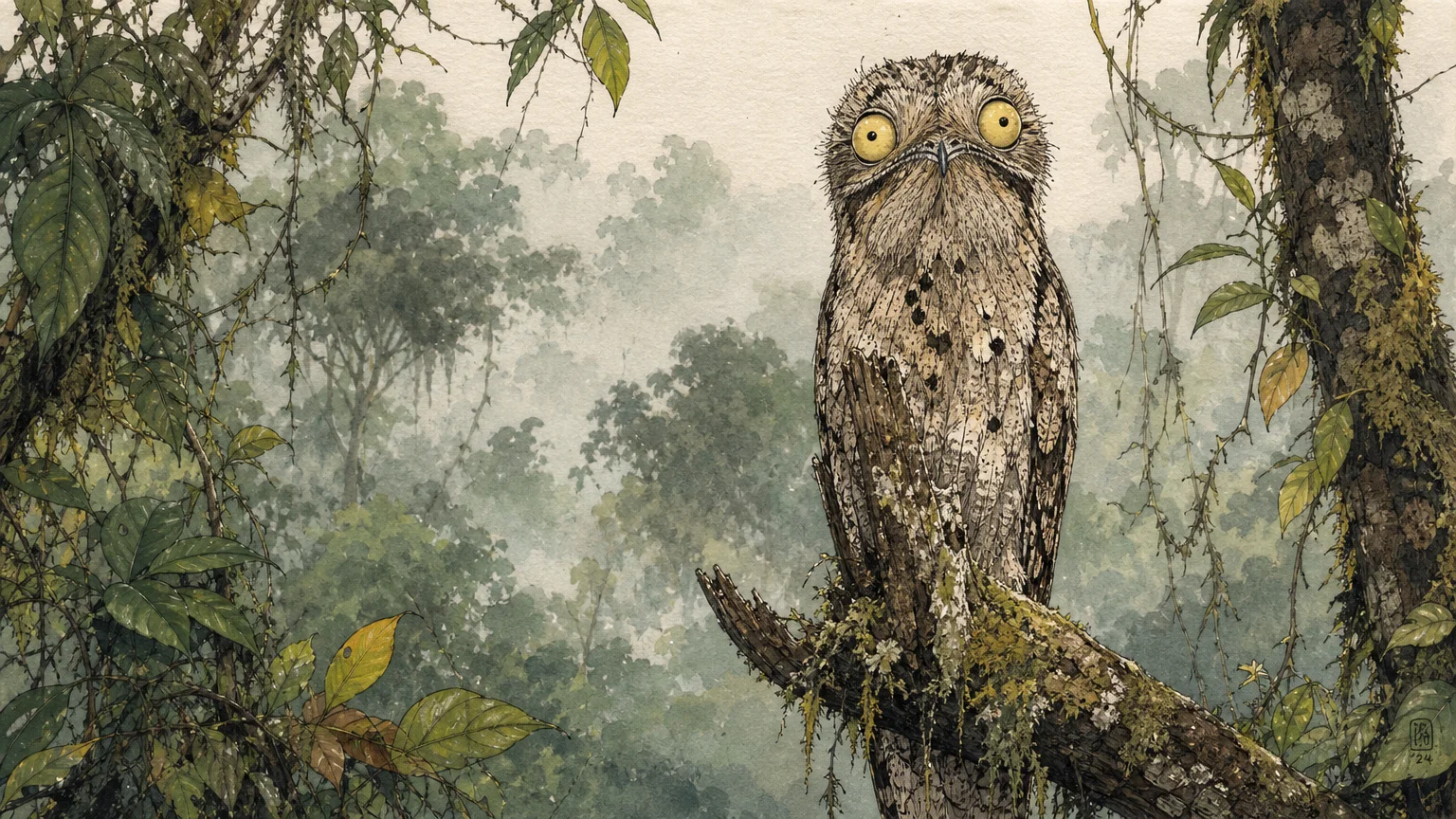
In the dense tropical rainforests of Central and South America, survival often depends on remaining completely undetected. The great potoo (Nyctibius grandis) is a nocturnal bird that has mastered the art of hiding in plain sight. Standing roughly 19 to 24 inches tall, this solitary insectivore spends its days perched at the tip of a dead branch.
Its mottled gray, black, and brown plumage flawlessly mimics the texture of tree bark. When a potential predator approaches, the potoo freezes, points its beak straight toward the sky, and transforms itself into a broken piece of wood. Even more impressively, the bird has tiny, specialized slits in its eyelids. These unique eye modifications allow the potoo to keep its eyes fully “closed” while still closely observing its surroundings, ensuring it never breaks its camouflage by revealing its bright yellow irises.
When darkness falls, the forest phantom drops its disguise. Using its massive, gaping mouth, the potoo swoops through the canopy to capture large beetles, moths, and katydids out of the air. Though rarely seen during the day, you can often locate them at night by listening for their haunting, mournful calls echoing through the trees.
The Prehistoric Pig-Deer: The Babirusa
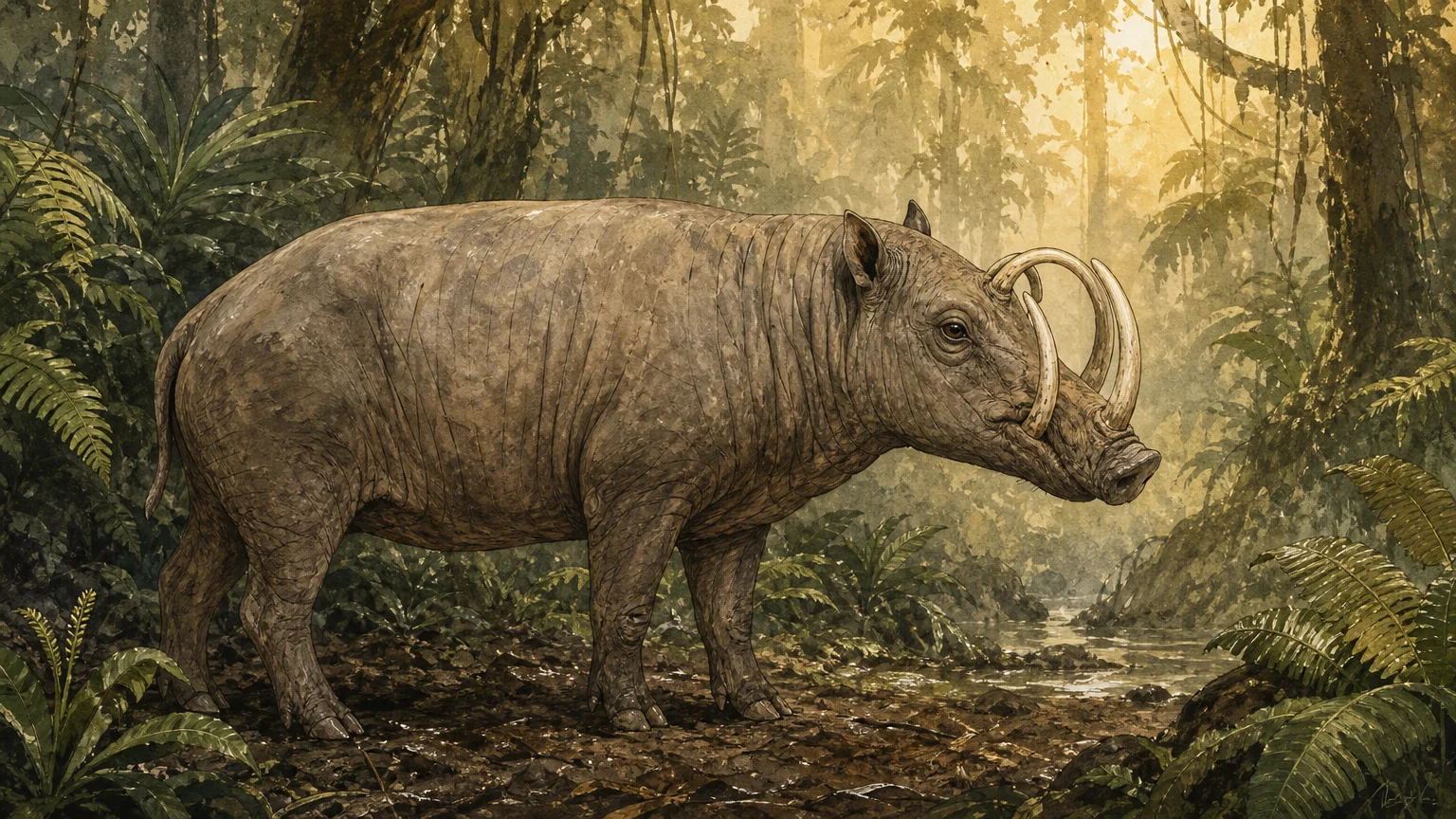
Native to the swamps and rainforests of the Indonesian island of Sulawesi, the babirusa is a wild pig with a dental configuration that defies logic. The name translates to “pig-deer” in the local Malay language, a nod to the bizarre, antler-like tusks that sprout from the males’ faces.
Unlike other wild boar species whose lower tusks jut outward for rooting in the dirt, the male babirusa’s upper canine teeth grow completely backward. They sprout vertically, piercing directly through the flesh of the snout, and curve back toward the animal’s forehead. Because these teeth grow continuously throughout the pig’s life—much like human fingernails—they can reach over 15 inches in length. If they are not broken off during the animal’s lifetime, the tusks can eventually grow directly into the babirusa’s skull.
While you might assume these intimidating tusks act as weapons, they are incredibly brittle and unsuited for combat. Evolutionary biologists theorize that because these pigs evolved on an isolated island without major predators, they did not need robust tusks for defense. Instead, the tusks function primarily as an evolutionary display of genetic fitness. When male babirusas fight over a mate, they stand on their hind legs and box each other with their front hooves, keeping their fragile dental hardware safely out of the fray.
Comparing the World’s Most Unusual Creatures
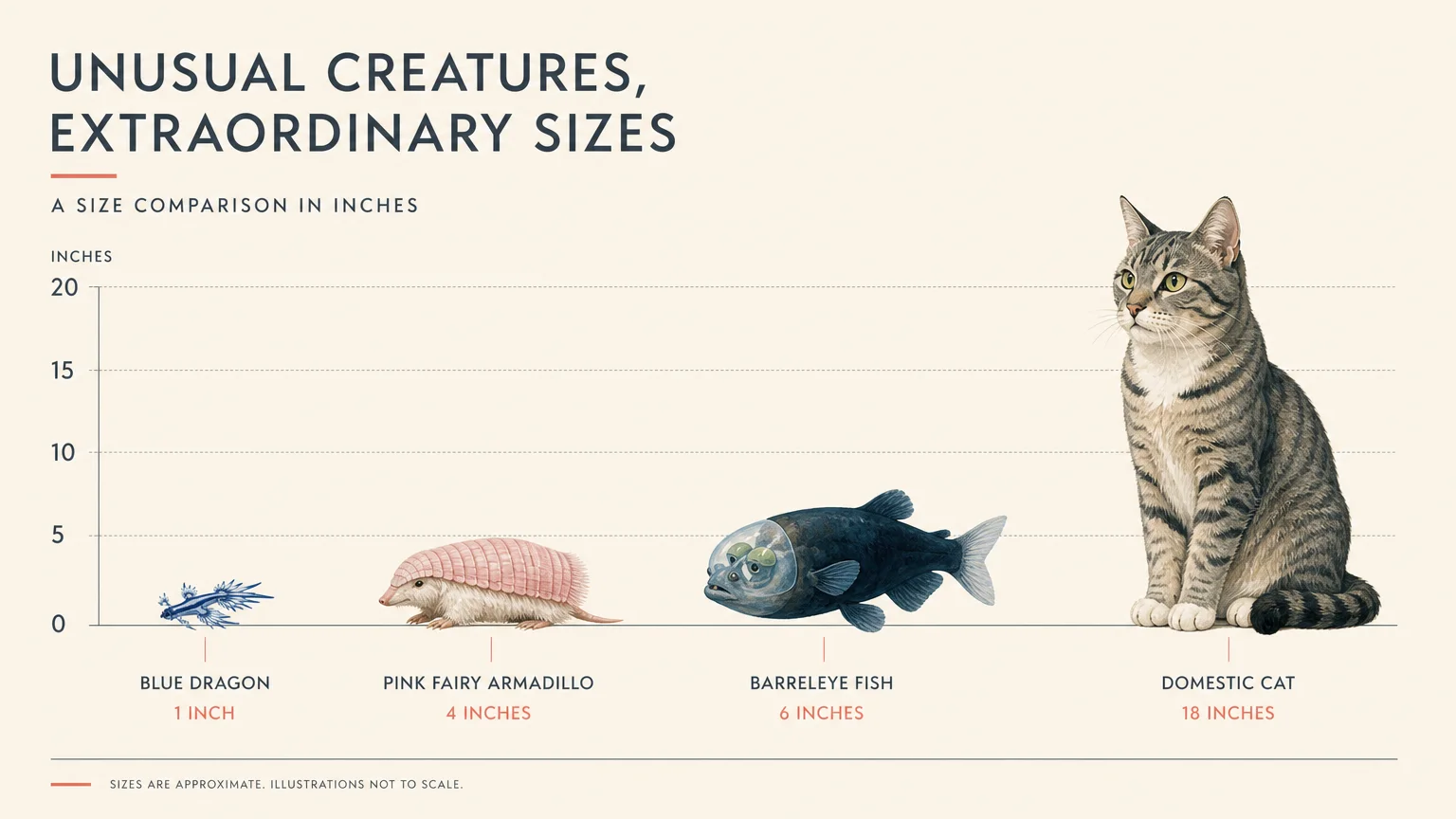
To put the sheer variety of these strange animals into perspective, here is a quick look at how their habitats, sizes, and unusual traits stack up against one another.
| Animal | Primary Habitat | Typical Size | Standout Evolutionary Feature |
|---|---|---|---|
| Barreleye Fish | Deep North Pacific Ocean | ~6 inches | Transparent head with rotating, tubular green eyes |
| Blue Dragon | Open Ocean (Surface) | ~1.2 inches | Steals and concentrates venom from its prey |
| Pink Fairy Armadillo | Sandy plains of Argentina | 3.5–4.5 inches | Pink shell acts as a built-in temperature regulator |
| Great Potoo | Central & South American Rainforests | 19–24 inches | Perfectly mimics a broken tree branch |
| Babirusa | Indonesian swamps and rainforests | Up to 220 pounds | Upper tusks pierce through the snout and curve backward |
Nature rarely designs for aesthetics; every bizarre physical trait—from a transparent skull to tusks that pierce the face—is a hyper-specific solution to a survival problem.
What This Incredible Biodiversity Means for You
It is easy to view these unusual creatures merely as fascinating wildlife facts or entertaining trivia. However, their extreme adaptations highlight the intricate balance of the ecosystems they inhabit. The great potoo controls dense populations of nocturnal insects that might otherwise decimate rainforest canopies. The babirusa turns over nutrient-rich soil in Indonesian swamps, promoting seed dispersal and forest growth. The blue dragon keeps populations of dangerous venomous siphonophores, like the Portuguese man o’ war, in check.
Furthermore, understanding these extreme evolutionary quirks helps researchers solve complex human problems. By studying how the pink fairy armadillo rapidly regulates its temperature, or how the blue dragon handles powerful neurotoxins without suffering cellular damage, scientists uncover new avenues for medical research and biomimicry. When you protect the strange and unseen parts of the natural world, you preserve the structural integrity of the entire planet.
How You Can Help Protect Strange Animals
Many of these animal discoveries are threatened by human activity, climate change, and habitat loss long before researchers fully understand them. You can directly support the survival of these rare species through everyday choices:
- Avoid the exotic pet trade: Do not attempt to keep exotic animals as pets. The pink fairy armadillo, for instance, is highly susceptible to stress and temperature fluctuations. According to the World Wildlife Fund, roughly 95 percent of these armadillos die within eight days if removed from their natural habitat. Appreciate wildlife from afar and stick to domesticated pets.
- Support deep-sea research: With an estimated 91 percent of marine species remaining undocumented according to organizations like the Ocean Census, funding for marine biology is critical. Support institutions that advocate for ocean conservation and deep-sea exploration.
- Vote with your wallet: Deforestation threatens terrestrial species like the great potoo and the babirusa. Purchase products with certified sustainable palm oil, look for bird-friendly shade-grown coffee, and choose responsibly sourced timber to help protect vital rainforest habitats.
Frequently Asked Questions
How many animal species are currently undiscovered?
While biologists have cataloged over two million species globally, experts estimate that millions more remain unknown. According to the Ocean Census, up to 91 percent of marine life alone has yet to be formally described by science. Finding these undiscovered species is an ongoing race against climate change and habitat destruction.
Can I keep a pink fairy armadillo or other exotic animal as a pet?
No. Exotic animals have highly specialized diets, behaviors, and environmental requirements that are impossible to replicate in a typical home. The pink fairy armadillo is notoriously sensitive to captivity; the vast majority do not survive beyond their first week in human care. Always leave wild animals in their natural habitats.
Why do the babirusa’s tusks grow into its skull?
The babirusa’s upper canines grow continuously throughout its life. Because the tusks are brittle and not used for physical combat, they do not naturally wear down quickly. If a male babirusa lives a long life and does not accidentally snap his tusks on a tree branch, the teeth can eventually curl entirely backward and pierce the skull.
Protecting our planet’s unusual creatures requires a mix of global conservation efforts and conscientious everyday choices. When you stay informed about animal discoveries and prioritize sustainable consumer habits, you help preserve the delicate ecosystems these animals call home. The next time you look at the ocean or a dense forest, remember the thousands of bizarre, specialized species thriving just out of sight.
This article provides general information only. Every reader’s situation is different—what works for others may not be the right fit for you. For personalized guidance on health, legal, or financial matters, consult a qualified professional.
Last updated: May 2026. Rules, prices, and details change—verify current information with official sources before acting on it.