At a Glance: How Dogs and Cats Show Affection Differently
While both species form deep emotional attachments to their human caregivers, their different evolutionary backgrounds mean they express that love in distinctly different ways. Here is how common bonding behaviors diverge between dogs and cats.
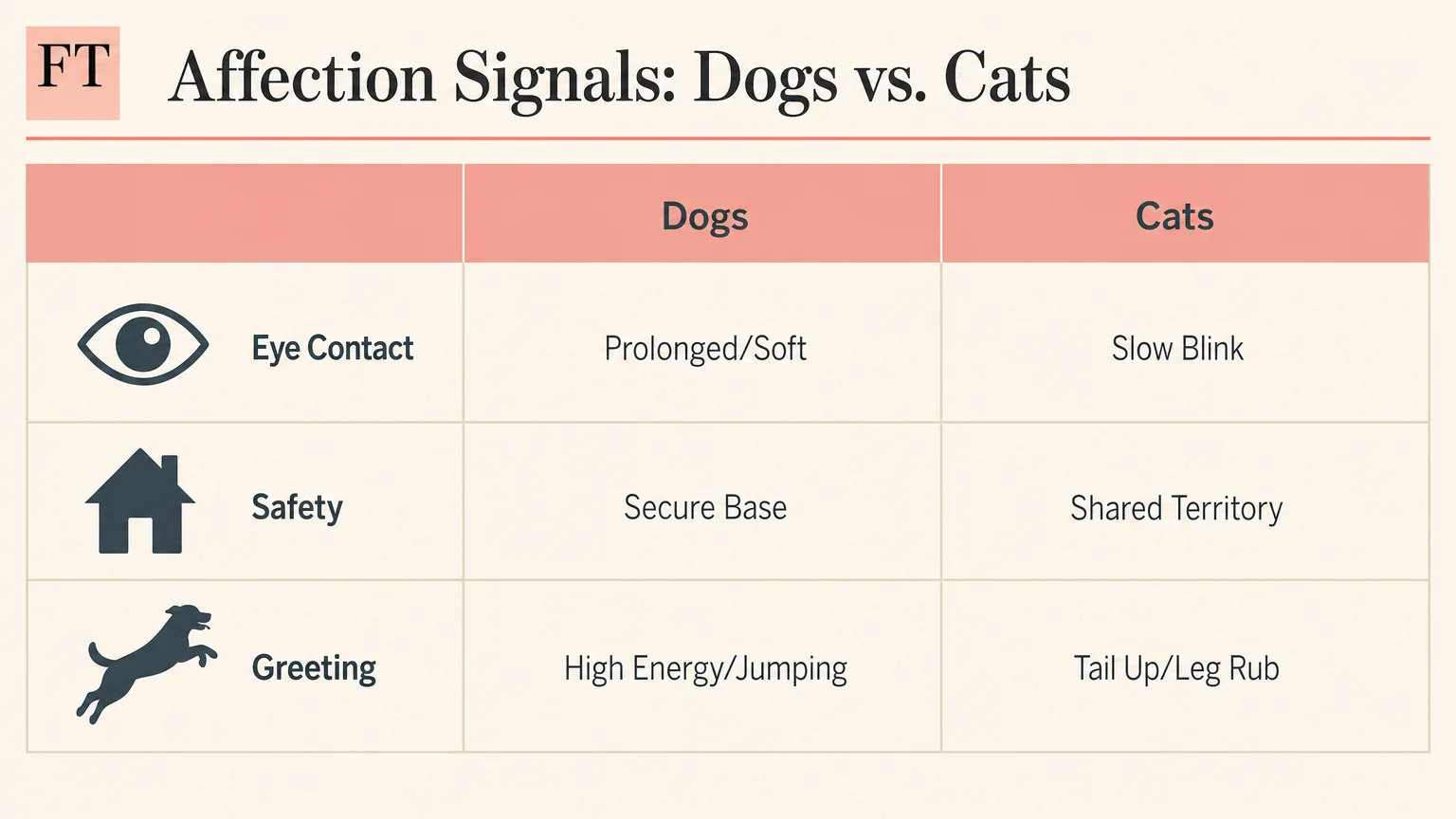
| Bonding Behavior | How Dogs Show It | How Cats Show It |
|---|---|---|
| Vocalizing | Whining softly, sighing when resting near you, or utilizing playful barks to initiate engagement. | Meowing, trilling, chirping, and utilizing distinct solicitation purrs. |
| Eye Contact | Seeking direct, soft eye contact to trigger a mutual oxytocin release. | Offering a slow blink to signal trust and positive emotion. |
| Scent Marking | Rolling on your belongings, carrying your shoes, or sleeping on your laundry. | Head-bunting and aggressively rubbing their cheeks against your hands or legs. |
| Physical Touch | Leaning their heavy body weight against your legs; resting their chin on your knee. | Kneading your lap (often called “making biscuits”); curling up directly on your chest. |
Frequently Asked Questions
How long does it take for a pet to bond with a new owner?
Animal welfare experts frequently reference the “3-3-3 rule” for rescued pets. Generally, it takes three days for an animal to decompress and stop feeling overwhelmed, three weeks to learn your routine and start showing their true personality, and three months to build a secure attachment and feel completely at home. Consistency, patience, and positive reinforcement are the most effective ways to accelerate this timeline.
Do cats feel as strong a bond with humans as dogs do?
Yes. Despite a persistent cultural stereotype that cats are aloof or entirely independent, behavioral research proves that cats form attachments to their owners that are just as secure as those seen in dogs. Cats simply express their emotional connections differently, relying heavily on subtle body language, scent marking, and physical proximity rather than the overt enthusiasm common in most dogs.
What does it mean if my pet follows me into the bathroom?
Following you from room to room—including into the bathroom—is a textbook example of the secure base effect. Because your pet views you as their primary source of safety, they want to maintain a line of sight to ensure you are safe and accessible. Furthermore, pack animals and colony felines naturally view communal activities as vital bonding opportunities.
Can a pet be too attached to their owner?
Yes; there is a distinct difference between a secure bond and hyper-attachment. A securely attached pet is thrilled to see you but can confidently relax, eat, and sleep when you are not home. Hyper-attachment often manifests as clinical separation anxiety, leading to destructive behaviors, excessive vocalization, or house-soiling when you leave. If your pet genuinely panics when you depart, consider working with a certified veterinary behaviorist.
Nurturing the Bond
Recognizing how your pet says “I love you” is the first step in deepening your relationship. Whether it is a subtle slow blink from across the room or a vigorous, right-sided tail wag at the front door, these behaviors are genuine expressions of immense trust. To continue building on that foundation, try incorporating these habits into your daily routine:
- Let them initiate: Allow your pet to come to you for physical affection rather than forcing interactions or picking them up when they are resting.
- Learn their baseline: Pay close attention to their normal resting posture and facial expressions so you can easily spot when they feel tense, anxious, or unwell.
- Reward the check-ins: When your dog looks back at you on a walk or your cat wanders into your office just to say hello, offer gentle praise to reinforce the connection.
By responding to their cues with patience and affection, you actively reinforce the safety of their environment and ensure your pet feels secure for years to come.
This is general informational content based on widely accepted guidance. Individual results vary. Verify current details—rules, prices, eligibility, regulations—with official sources before making important decisions.
Last updated: June 2026. Rules, prices, and details change—verify current information with official sources before acting on it.