More Than Just Color: What Else Makes Canine Vision Unique?
While the color debate gets most of the attention, it’s only one piece of the puzzle. Several other factors make a dog’s visual experience vastly different from our own. Understanding these unique traits helps us appreciate the world from their perspective and cater to their natural strengths.
Masters of Motion and Low Light
If cones are the color artists, rods are the motion detectors and night-vision specialists. And in this department, dogs have a significant advantage. A dog’s retina is packed with far more rods than a human’s. This high concentration of rods grants them two major visual superpowers.
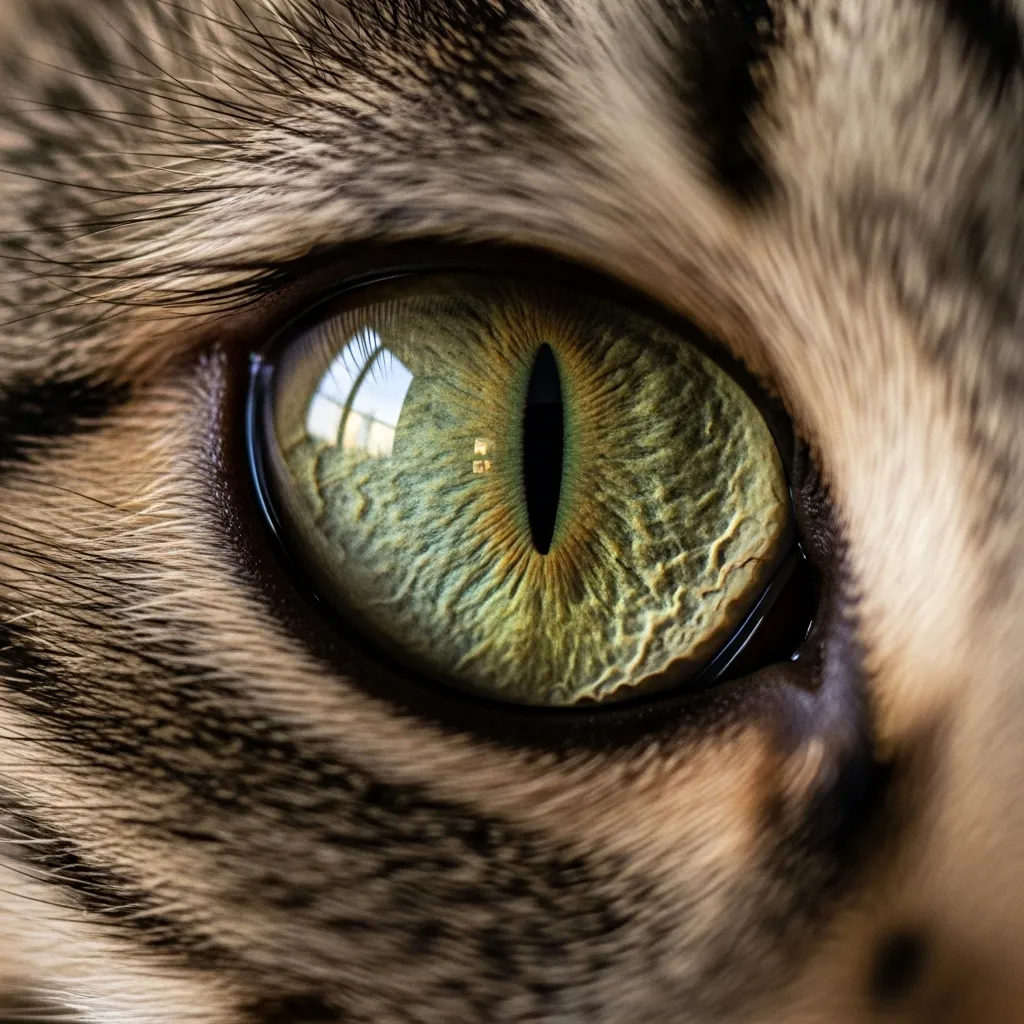
First, they have exceptional vision in dim light. Their ability to see clearly at dawn and dusk (known as crepuscular vision) is a throwback to their wild ancestors who did most of their hunting during these twilight hours. You might notice your dog is often most active and alert in the early morning or as the sun sets. This is their biology at work. They also have a special reflective layer behind their retina called the tapetum lucidum. This structure acts like a mirror, bouncing light back through the retina a second time, giving the rods and cones another chance to absorb it. It’s also what causes that spooky-looking “eyeshine” you see when a light catches their eyes in the dark.
Second, their eyes are incredibly sensitive to movement. That high density of rods allows them to detect even the slightest flicker or motion at great distances. This is why your dog can spot a squirrel twitching its tail a block away, even if the squirrel itself is just a blurry speck. This sensitivity was vital for spotting both prey and potential threats in the wild. In our modern world, it explains why they can be so reactive to joggers, cyclists, or other dogs passing by the window.
Field of Vision and Depth Perception
The placement of a dog’s eyes on their head also plays a big role in what they see. Most dog breeds have eyes set more on the sides of their head compared to our forward-facing eyes. This gives them a much wider field of peripheral vision. While a human’s field of view is about 180 degrees, a dog’s can be 240 degrees or more, depending on the breed. This panoramic view allows them to scan their environment without turning their head, another excellent adaptation for spotting movement from nearly any direction.
However, this wider view comes with a trade-off: depth perception. The area where the visual fields of both eyes overlap is called binocular vision, and it’s what gives us our sharp, 3D sense of the world. Because our eyes are right at the front of our face, our binocular vision is excellent. A dog’s binocular vision is much narrower. This means their depth perception is not as precise as ours, which might explain why a dog sometimes misjudges a jump or has trouble catching a treat tossed directly at them.
A Blurry World Up Close?
Another surprising dog fact is related to their visual acuity, or the ability to see fine details. Generally speaking, dogs are more nearsighted than people. Using the standard eye chart as a measure, what a person with 20/20 vision can see clearly from 75 feet away, a dog would likely need to be just 20 feet away to see with the same level of detail.
To them, the world might appear a bit softer and less detailed than it does to us, especially for stationary objects. Again, this isn’t a defect; it’s an adaptation. For a creature that relies heavily on motion and smell, being able to read the tiny print on a sign is simply not a biological priority. It’s worth noting that vision does vary by breed. Sighthounds like Greyhounds, for example, were bred for spotting prey at vast distances and tend to have much sharper long-distance vision than other breeds.