Your Birdwatching Toolkit: Getting Started
One of the best things about backyard birdwatching is that you don’t need a lot of fancy equipment to begin. Your own eyes and ears are your most important tools. However, a few simple items can greatly enhance your experience and help you learn faster.
Essential Gear (and What You Can Skip)
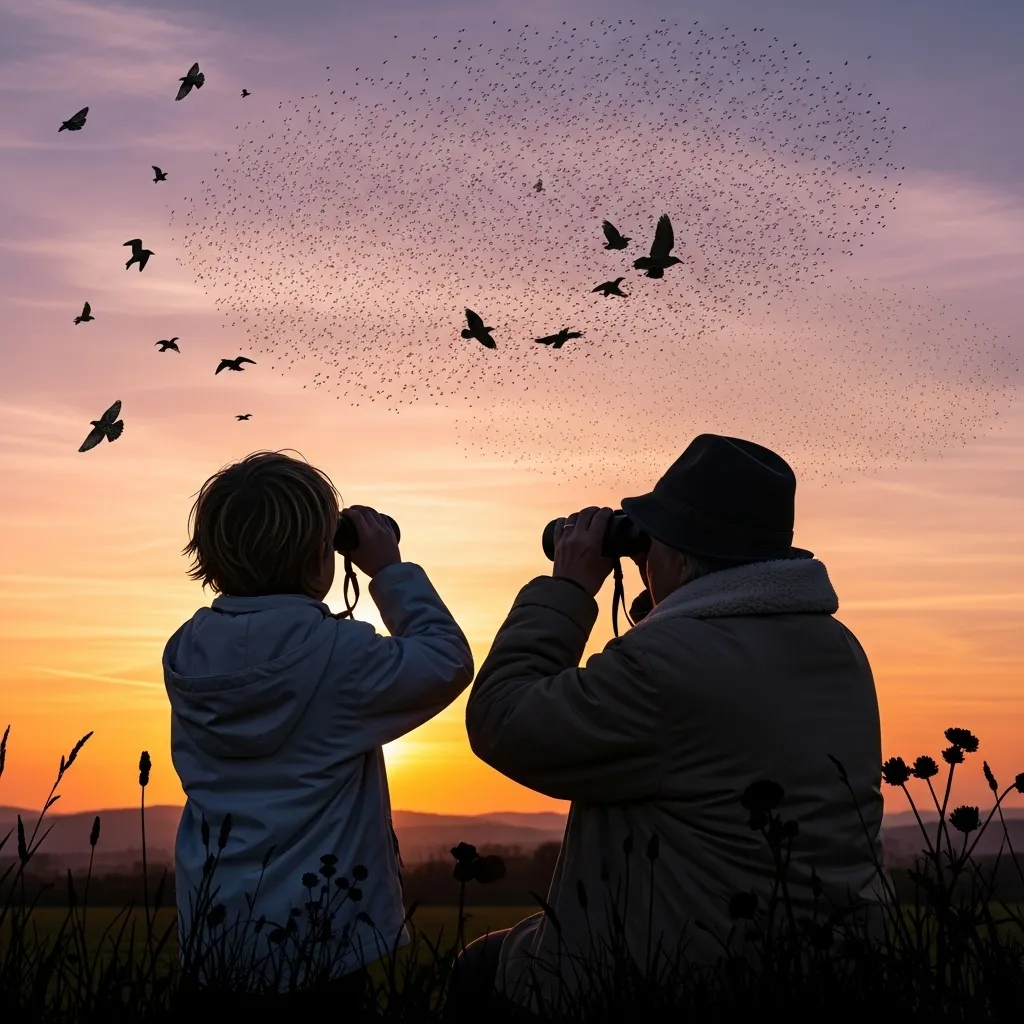
Binoculars: While not strictly necessary at first, a good pair of binoculars will revolutionize your birdwatching. They bring distant birds into sharp, clear focus, allowing you to see details like the subtle stripes on a sparrow or the iridescent shimmer on a grackle’s feathers. You don’t need to spend a fortune. A great all-purpose choice for beginners is a pair with 8x magnification and 42mm objective lenses (written as 8×42). This provides a stable, bright image that’s easy to handle.
A Field Guide or App: A field guide is essential for answering the question, “What bird is that?” Traditional field guidebooks, like those by Sibley, Peterson, or National Geographic, are wonderful resources filled with beautiful illustrations and detailed information. However, for many beginners, a smartphone app is even more convenient. The Merlin Bird ID app from the Cornell Lab of Ornithology is a game-changer. It’s free and can help you identify a bird with a few simple questions, a photo, or even by listening to its song. The Audubon Bird Guide app is another excellent free option.
A Notebook: Consider keeping a simple journal. You can jot down the date, the weather, and the birds you see. You might note their behaviors—what were they eating? Were they singing? Chasing each other? Over time, your notebook will become a personal record of the life in your backyard and a wonderful tool for noticing seasonal patterns.
The Art of Observation: What to Look For
When a new bird appears, it can be tempting to immediately grab your field guide. But first, just take a moment to watch. Pay attention to a few key characteristics, which will make your identification search much easier.
Size and Shape: Is the bird smaller than a sparrow, about the size of a robin, or larger like a crow? Notice its general shape. Is it plump and round like a dove or slender and sleek like a finch? What does its beak look like—short and thick for cracking seeds, or long and thin for probing for insects?
Color Pattern: Look for dominant colors, but also for the placement of those colors. Does it have a crest on its head? Stripes above its eyes? White bars on its wings? A brightly colored belly? These field marks are the clues that will lead you to a positive ID.
Behavior: How does the bird act? Is it hopping on the ground, clinging to the side of a tree trunk, or soaring high overhead? Is it alone or in a flock? Its behavior is a huge part of its identity.
Song and Call: With practice, you can learn to identify birds by their sounds alone. Many apps, including Merlin, have features that help you identify birds by their songs. Start by learning the song of one common bird, like the cheerful “cheer, cheer, cheer” of the Northern Cardinal.