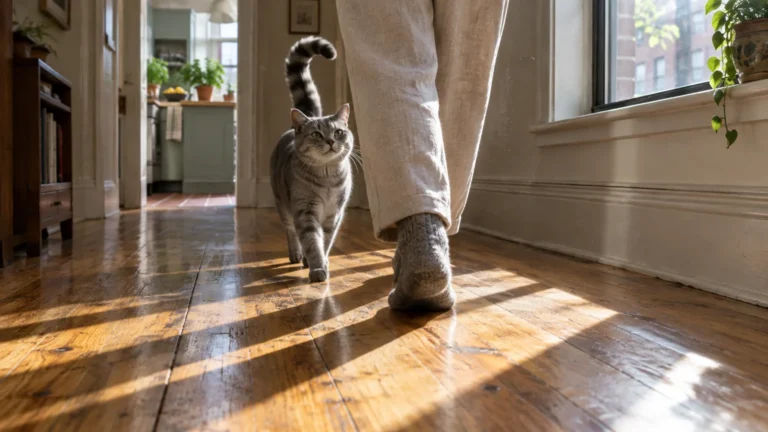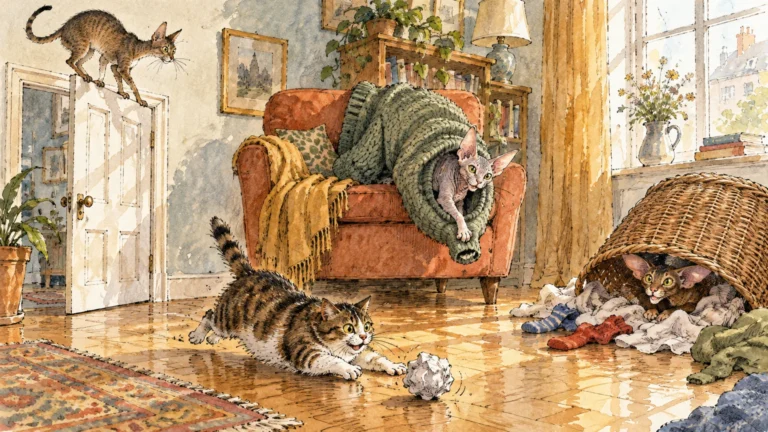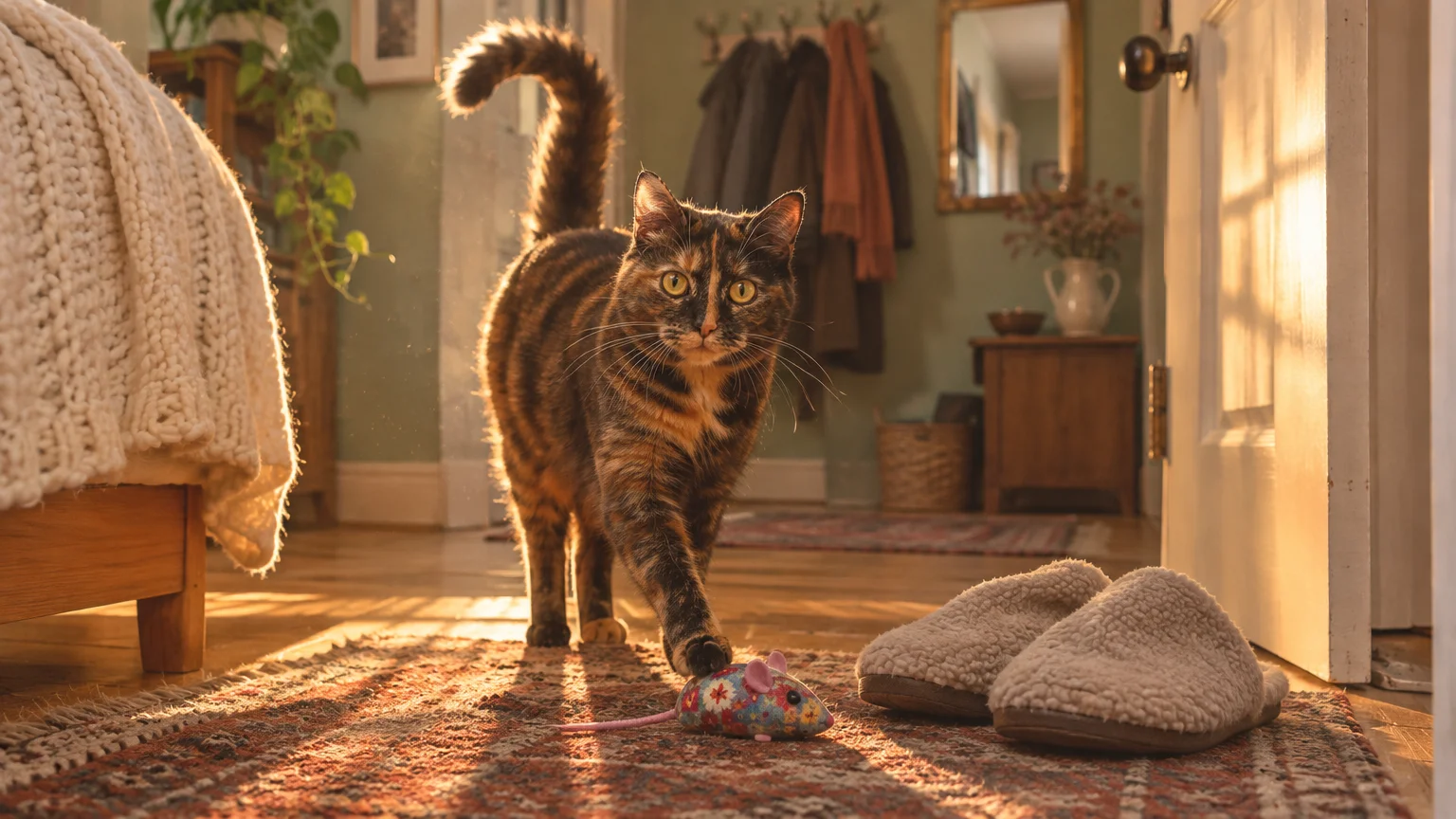
You step out of bed and spot a limp mouse on your bathmat—or a plush toy dropped beside your coffee mug. That unexpected delivery feels personal, yet it rarely means what pet owners assume.
Animal behaviorists link these deliveries to hardwired feline biology rather than human-style generosity. When your cat brings gifts or drops cat presents at your feet, deep predatory drives and territory habits are taking over.
Learning what sparks this cat behavior helps you respond calmly, protect local wildlife, and channel your pet’s energy into safer daily routines.
What Experts Say Really Drives Those Unwanted Presents
Domestic cats (Felis catus) remain obligate carnivores whose ancestors lived alongside humans largely for rodent control. Because selective breeding did very little to alter their predatory drive, your house cat still carries strong wild instincts.
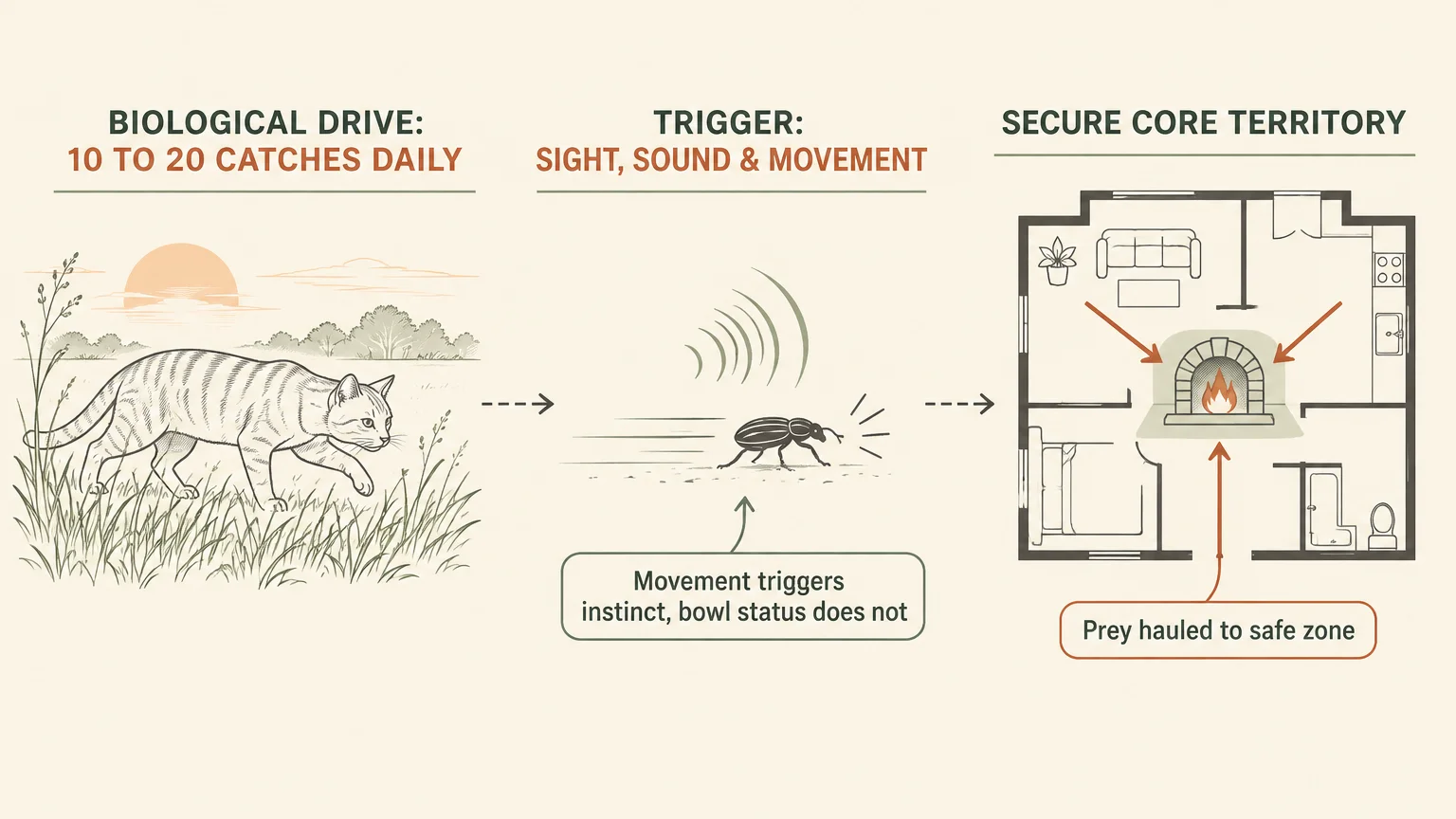
According to International Cat Care, hunting behavior starts with the sight, sound, and smell of movement and peaks at dawn and dusk. Even well-fed pets feel that biological urge whenever something scurries or flutters nearby.
Without human-provided meals, a cat must catch and eat 10 to 20 small prey items every single day. In the wild, cats spend up to half of their day searching for, capturing, and eating food.
That relentless biological schedule explains why cats hunt even when their food bowls sit full. Hunger does not pull the hunting trigger; movement and opportunity do.
Your Home Is a Safe Core Territory
International Cat Care and veterinary guidance on PetMD note that cats often bring prey indoors because they view your house as their core territory. To a cautious predator, your living room feels like a secure base to eat, play, or stash a catch.
Rather than flattering you with a trophy, your cat is simply hauling valuables back to a safe zone. Leaving a mouse beside your shoes happens because you and your doorway sit at the center of that protected space.
Maternal Provisioning and Teaching Habits
In nature, mother cats wean kittens onto dead prey—and later live prey—so young cats practice stalking and killing. Behaviorists cited by International Cat Care and PetMD note that adult pets often replay that provisioning sequence with trusted humans.
Even spayed females and neutered males display this caregiving pattern. Your cat may treat you like an inexperienced family member who still needs lessons in securing dinner.
Social Bonding and Invitations to Play
Indoor-only cats frequently carry soft toys over to their owners while meowing or yowling. PetMD notes that this vocal delivery initiates interactive play and strengthens your social bond.
Instead of hunting for survival, your cat uses a familiar prey-carrying routine to grab your attention. Responding with a quick game validates that connection without encouraging real wildlife catches.
How Often Do Outdoor Cats Actually Bring Prey Home?
If your outdoor cat drops two or three mice on the porch each month, you are seeing only a fraction of the story. Most successful hunts never make it back through the cat flap.
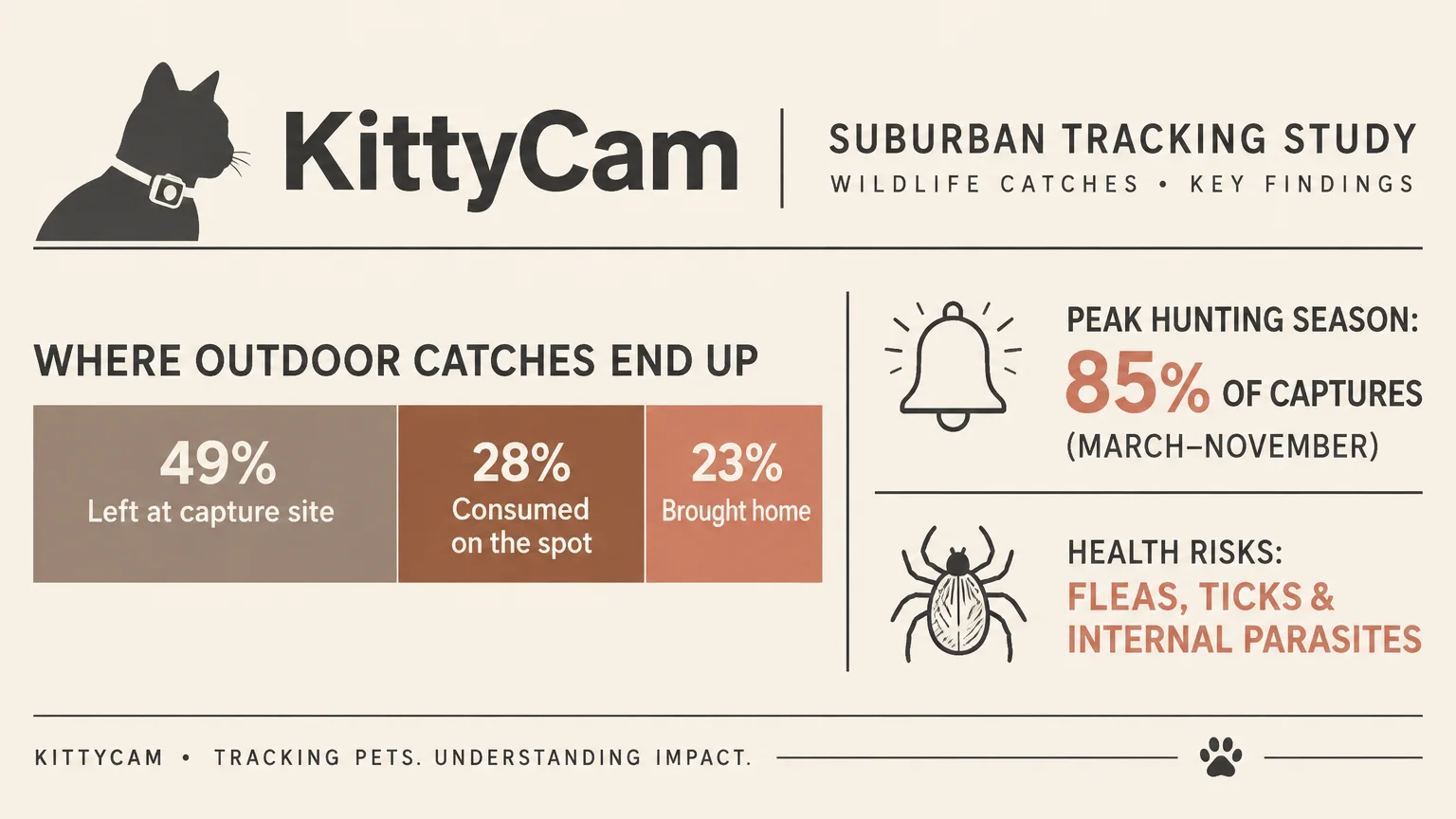
Researchers conducted a year-long study from November 2010 through October 2011 using animal-borne KittyCams on 55 owned, free-roaming cats in suburban Georgia. Published in Biological Conservation in 2013, the seven-to-ten-day camera tracking revealed what owners rarely witness.
Across the tracked cats, 44 percent hunted wildlife and 29 percent captured prey, with successful hunters averaging 2.4 catches per tracking window. Yet those cats brought home only 23 percent of the animals they caught.
Cats left 49 percent of their catches right at the capture site and ate another 28 percent on the spot. Warm weather drove most of that hunting, with 85 percent of captures happening between March and November.
Free-roaming pets also concentrate their hunting close to home, magnifying local pressure on birds and small mammals. A March 2020 study led by North Carolina State University researchers tracked 925 pet cats across six countries using GPS units and prey reports.
Those cats stayed largely within a 100-meter radius of home, concentrating predation in backyard habitats. As a result, pet cats exerted a 2- to 10-times larger impact on local wildlife than similar-sized wild predators.
National estimates show how rapidly modest monthly totals scale up. A 43-month UK survey conducted from 2018 to 2021 across 553 cats—published in March 2025—estimated that Britain’s 10.8 million pet cats bring home 37.25 million to 140.4 million prey items yearly.
Mammals accounted for 83 percent of those returned UK catches. Most cats brought back zero or one animal per month, while a small minority of prolific hunters delivered more than 15 per month.
In the United States, a widely cited 2013 systematic review in Nature Communications estimated that free-ranging domestic cats kill 1.4 to 3.7 billion birds and 6.9 to 20.7 billion mammals annually.
Authors of that review attributed 69 percent of bird mortality and 89 percent of mammal mortality to un-owned stray or feral cats. Some cat advocacy groups dispute how the researchers extrapolated those national totals.
Why Indoor Cats Bring You Toys, Socks, and Hair Ties
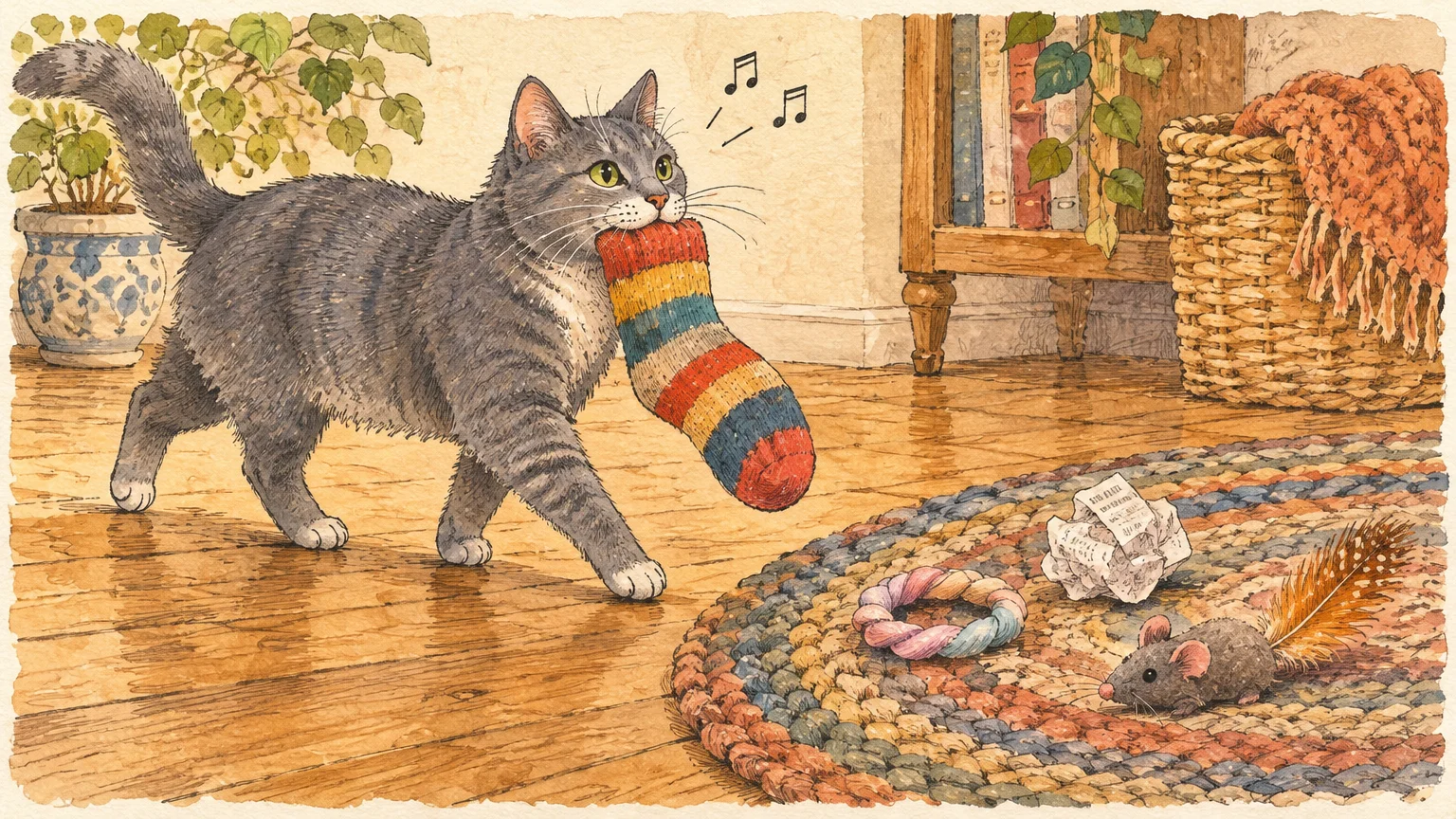
Keeping your cat indoors removes access to songbirds and field mice, yet it leaves every hunting circuit intact. Your indoor cat still feels surging energy around dawn and dusk and looks for targets that mimic small prey.
A rolled-up sock, a crinkly wrapper, or a plastic spring skitters across hardwood floors much like a darting rodent. Once your cat stalks and pounces on that object, the same territory instinct takes over.
Carrying the captured item to your bed or dropping it beside your chair completes the hunting sequence. If your cat yowls with a plush mouse clamped in its jaws, it is likely announcing a catch and inviting you to play.
Cats often choose your bed, couch, or shoes as drop zones because those spots smell strongly of you. To your cat, your scent marks the safest corner of your shared core territory.
You can encourage harmless toy deliveries without inviting midnight chaos or choking hazards. Store hair ties, rubber bands, ribbons, and thread inside closed drawers so your cat never swallows a makeshift prize.
Rotate three or four safe plush mice or crinkle balls every few days to keep familiar toys feeling fresh. Reward morning toy deliveries with calm praise and a brief chin scratch so your cat feels acknowledged.
Science-Backed Ways to Reduce Prey Deliveries
If your outdoor cat brings home real wildlife, scolding will not change tomorrow’s catch. Proven adjustments to nutrition, daily play, and collar visibility can sharply reduce the number of animals your cat captures.
In a 12-week controlled trial published in Current Biology in 2021, University of Exeter researchers tested five non-invasive methods on 355 cats across 219 UK households. The results revealed clear winners alongside two surprising misfires.
| Method Tested | Impact on Prey Brought Home | Why It Worked or Backfired |
|---|---|---|
| High-meat, grain-free food | Reduced total prey by 36% (and birds by 44%) | Supplies complete meat-based nutrients that plant-heavy kibble may lack |
| 5–10 minutes of daily object play | Reduced total prey by 25% | Satisfies stalking, chasing, and pouncing drives indoors |
| Brightly colored collar covers (Birdsbesafe) | Reduced birds by 42% (no effect on mammals) | Alerts sharp-eyed birds before your cat gets within pouncing range |
| Bell collars | No discernible effect on prey returned | Gave no measurable benefit in the trial |
| Puzzle feeders (with usual dry food) | Increased total prey brought home by 33% | Slowing dry-food intake may have left outdoor cats hungrier |
Switching to a high-meat, grain-free diet produced the steepest overall drop in hunting deliveries. Researchers suggested that formulas relying heavily on plant proteins may leave cats seeking specific amino acids or micronutrients through real prey.
Transition gradually over seven to ten days whenever you change your cat’s diet to prevent stomach upset. Ask your veterinarian before altering meals if your cat has kidney disease, food allergies, or other medical conditions.
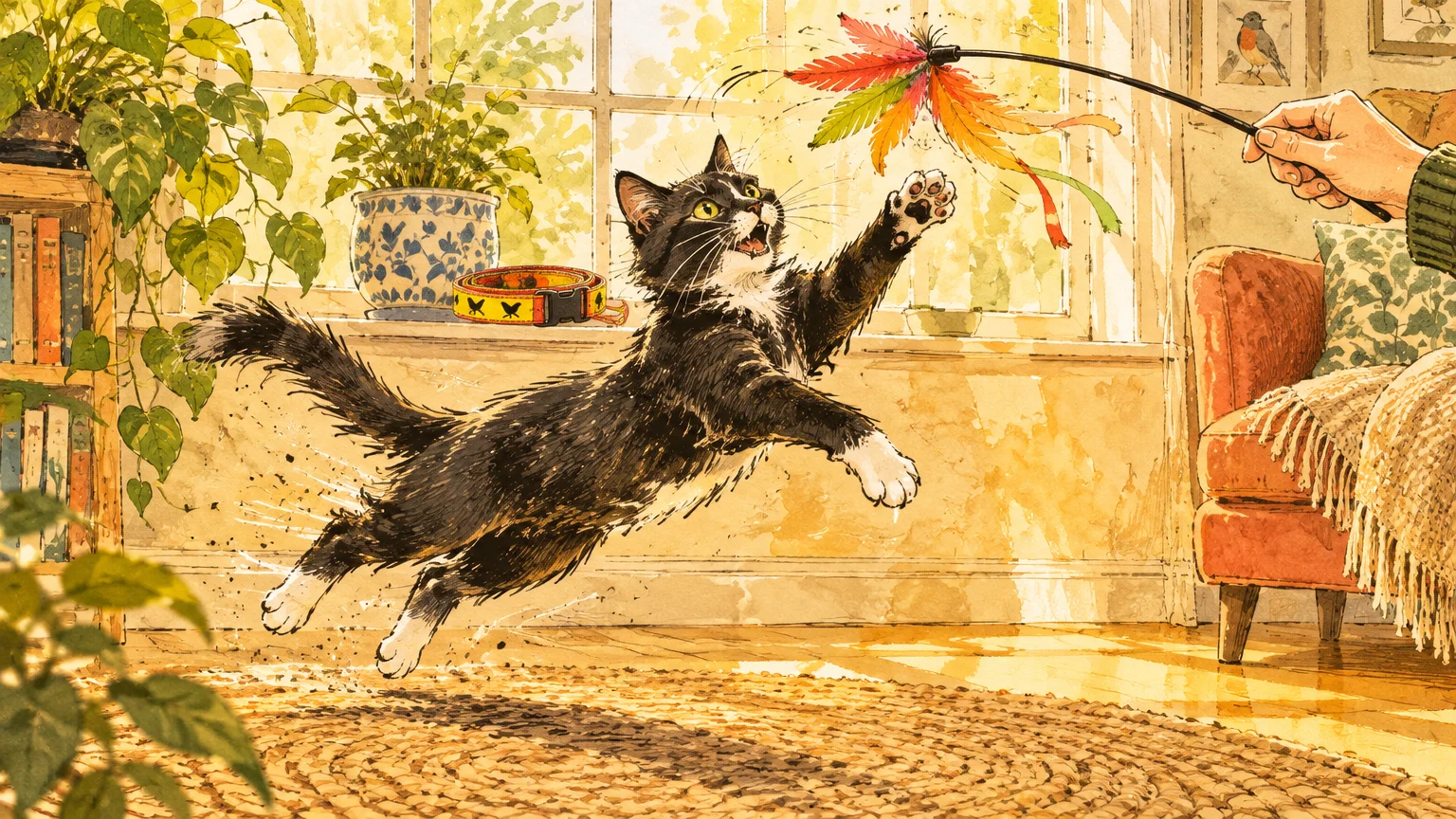
Five to ten minutes of structured object play ranked right behind diet changes and costs almost nothing to start. Let your cat stalk, chase, and pounce on a feather wand, then toss a toy mouse so your cat finishes with a mock catch.
Brightly colored collar covers—such as Birdsbesafe sleeves—stand out sharply against grass and tree bark, giving songbirds crucial seconds to fly away. Because bright covers did not reduce mammal catches, pairing them with diet and play changes offers broader protection.
Skip dry-food puzzle feeders if your cat roams outside and hunts wildlife. In the Exeter trial, making cats work harder for standard kibble appeared to leave them hungrier and drove prey returns up by 33 percent.
Whenever your cat wears an ID tag or bird-deterrent cover, choose a breakaway safety collar that snaps open if snagged on a fence or branch.
Both the American Humane Society and The Animal Medical Center advise fitting collars so two to three fingers slip easily underneath, paired with a microchip.
What to Do the Moment Your Cat Drops Prey at Your Feet
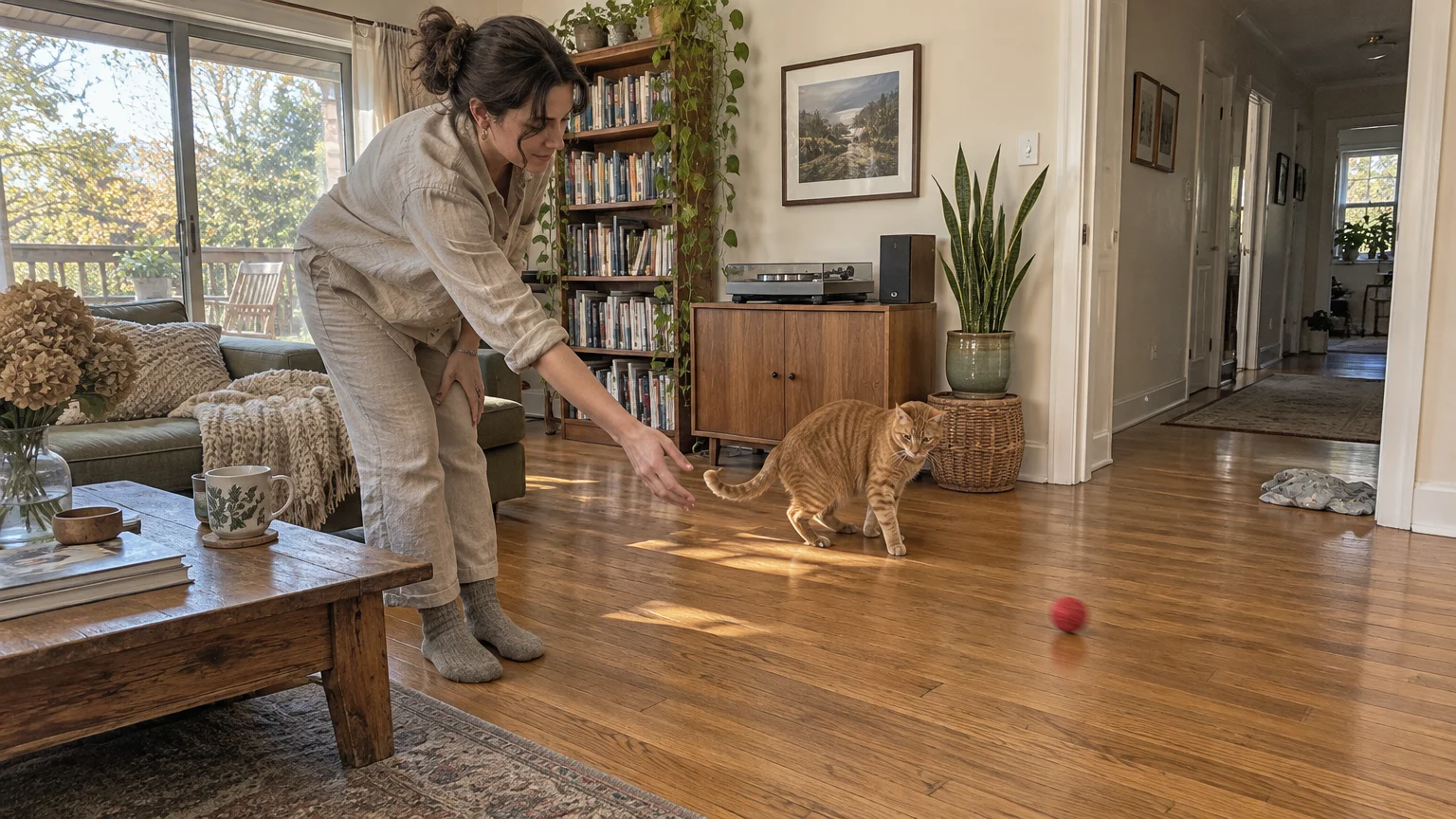
Spotting a mouse or songbird on your rug triggers an instant urge to react, especially if the animal is still moving. Following a calm routine protects your cat, your hands, and any surviving wildlife.
Never yank a live catch straight out of your cat’s mouth with bare hands. Grabbing prey mid-clamp risks painful bites or scratches and teaches your cat to bolt under furniture with future catches.
- Skip the scolding: Veterinary-reviewed guidance from International Cat Care stresses that punishing your cat creates fear and confusion rather than stopping instinctive hunting.
- Separate your cat calmly: Toss a favorite toy or treat into another room, then gently close a door so you can inspect the area safely.
- Never release a live catch back outside: Cat saliva and claws harbor Pasteurella multocida bacteria, which causes fatal septicemia in birds and small mammals, often within 24 to 48 hours—even when no puncture wounds appear.
- Contain injured wildlife safely: Wearing gloves or using a soft towel, place any live animal inside a dark, quiet, ventilated cardboard box away from pets and household noise.
- Seek immediate wildlife treatment: The Wildlife Center of Virginia, Wildlife Center of North Georgia, and University of Illinois veterinary guidance urge taking cat-caught wildlife straight to a veterinarian or permitted wildlife rehabilitator for antibiotics and shock care.
- Clean up thoroughly and redirect: Pick up dead prey using disposable gloves or an inverted bag, scrub your hands with soap and water, and offer a brief wand-toy session to burn off leftover adrenaline.
Handling deliveries without shouting keeps your cat comfortable sharing space with you. Redirecting leftover energy onto a feather toy also reinforces which targets belong in your living room.
Safe Enrichment and Outdoor Alternatives That Satisfy Hunting Instincts
Keeping your cat indoors is the only sure way to stop wildlife hunting and end backyard prey deliveries altogether. However, keeping a cat safe inside four walls is only half of good feline care.
In a September 2025 policy update highlighted by the American Veterinary Medical Association (AVMA), the Feline Veterinary Medical Association stressed that physical safety alone falls short—indoor cats need active environmental enrichment.
To satisfy natural cat instincts indoors, the American Animal Hospital Association (AAHA) recommends building daily enrichment into your home:
- Prey-mimicking toys: Schedule wand or motorized teaser sessions at dawn and dusk to match your cat’s natural energy peaks.
- Vertical perches: Add sturdy cat trees or cleared high shelves so your cat can climb, survey rooms, and relax above floor traffic.
- Scratching posts: Place tall sisal posts near doorways and sleeping areas so your cat can stretch muscles and mark territory safely.
Move wand toys the way real prey behaves rather than dangling feathers right in front of your cat’s nose. Drag lures slowly behind chair legs, pause near corners, and let your cat crouch before darting the toy away.
If your cat misses fresh air and sunshine, you still have safe alternatives to unsupervised roaming. The American Bird Conservancy recommends enclosed catios, cat-proof yard fencing, or trained harness-and-leash walks.
Even a compact window-box catio lets your cat smell breezes, chatter at birds, and soak up sunlight without touching local wildlife. Harness walks require gradual indoor practice and patience, yet many curious cats enjoy supervised backyard exploration.
Things to Watch Out For
Even routine cat behavior introduces real wildlife and household health pitfalls when wild animals enter your home. Watch closely for these five common mistakes:
1. Releasing “Unharmed” Live Wildlife Back Outside
A sparrow or chipmunk that hops across your patio after escaping a cat rarely survives on its own. Bacteria from cat teeth and claws often cause fatal blood infections within one to two days unless a professional starts antibiotic treatment quickly.
2. Toxoplasmosis Exposure From Hunting, Litter, and Soil
Cats are the only definitive hosts for Toxoplasma gondii, a parasite they contract by eating infected rodents, birds, or raw meat.
Guidance from the Centers for Disease Control and Prevention (CDC), Cornell University, and Mayo Clinic explains that newly infected cats shed parasite oocysts in feces for 10 to 14 days.
Shedding starts 3 to 10 days after exposure, and those oocysts turn infective 1 to 5 days after leaving the cat. Once infective, T. gondii oocysts can survive in garden soil or water for well over a year.
More than 30 million to over 60 million people in the United States carry T. gondii, often without noticing symptoms. However, infection poses grave risks—including miscarriage, birth defects, and severe eye or brain illness—to pregnant women and immunocompromised people.
Scoop litter boxes every single day so feces leave your home before oocysts reach their one-to-five-day infective window. CDC hygiene guidance also advises wearing gloves when gardening outside and washing hands thoroughly with soap and water afterward.
3. Plague, Tularemia, and Internal Parasites
CDC veterinary guidance and Kansas Veterinary Diagnostic Lab resources warn that cats hunting wild rodents, rabbits, or hares can contract tularemia (Francisella tularensis) and plague (Yersinia pestis). Infected cats can transmit these serious bacteria via bites, scratches, infectious fluids, respiratory droplets, or fleas brought indoors.
Eating wild catches also exposes cats to intestinal parasites such as roundworms and tapeworms. Keep outdoor hunters on veterinarian-recommended flea and parasite preventives, and wash your hands after touching cats or their dishes.
4. Non-Breakaway Collars on Outdoor or Active Cats
Standard buckle collars can catch on tree limbs, fences, or even household cabinet handles and trap your cat. Always choose a breakaway collar tested to release under weight, and check the two-to-three-finger fit every few weeks.
5. Assuming Bell Collars or Dry-Food Puzzles Stop Hunting
Relying on a tiny collar bell gives many pet owners false confidence while birds remain at risk. Controlled trial evidence showed bells had no measurable effect on returns, whereas high-meat diets, daily wand play, and bright collar covers produced real drops.
When DIY Isn’t Enough
Most toy deliveries and harmless backyard quirks respond smoothly to better play routines and diet tweaks. Contact a licensed veterinarian, wildlife specialist, or physician promptly in these four scenarios:
- Your cat brings home live, injured wildlife: Do not attempt home nursing or release; take the boxed animal straight to a veterinarian or permitted wildlife rehabilitator for antibiotics and shock treatment.
- Your cat gets sick or bitten after hunting rodents or rabbits: Book an urgent veterinary exam if your cat develops fever, lethargy, poor appetite, or swollen glands, and contact your doctor immediately if a hunting cat bites or scratches you.
- Someone in your household is pregnant or immunocompromised: Ask your physician and veterinarian about strict Toxoplasma precautions, keeping cats indoors, gardening with gloves, and assigning daily litter box duty to someone else.
- Indoor hunting frustration turns into aggression or relentless night yowling: Schedule a veterinary checkup to rule out pain or thyroid issues before working with a qualified feline behavior specialist on tailored enrichment.
Frequently Asked Questions
Why does my cat meow loudly while carrying a toy?
Loud yowling or trilling while carrying a plush mouse mimics the vocal signals cats use to announce a catch. For indoor cats, PetMD notes this delivery usually serves as a direct invitation for you to play and bond.
Should I praise my cat for bringing me a dead mouse?
Stay neutral rather than scolding or throwing an excited party. Quietly remove the dead mouse with gloves, avoid punishing natural cat instincts, and redirect your pet’s lingering energy onto a feather wand in another room.
Do bell collars stop cats from catching birds?
No—the 2021 University of Exeter trial found that bell collars had no discernible effect on how many animals cats brought home. Switching to a brightly colored breakaway collar cover cut bird returns by 42 percent in that same study.
Why does my well-fed cat still hunt and bring gifts?
Hunting and hunger run on separate biological circuits, so a full bowl does not turn off motion-triggered prey drives. Cats also seek specific meat-based nutrients and stimulation, which is why high-meat diets and daily wand play curb outdoor hunting.
Why does my cat drop toys in my bed or shoes?
Your bed and shoes carry your scent and sit at the heart of what your cat considers its safest core territory. Dropping toys there keeps prized “catches” secure while inviting you to join the fun.
Your Next Step for Happier Play and Safer Wildlife
Pick one simple shift tonight: run a ten-minute wand play session before dinner, plan a high-meat diet transition, or explore a safe patio catio. Honoring your cat’s natural instincts while steering them toward toys keeps both your pet and neighborhood wildlife safer.
The information here is meant for educational purposes; specific circumstances—including health conditions, finances, location, and goals—may require different approaches. When in doubt, consult a licensed professional or check official sources directly.
Last updated: November 2026. Rules, prices, and details change—verify current information with official sources before acting on it.