
Your dog often detects danger long before you notice any threat. Canine biology turns subtle environmental clues into rapid survival alerts.
While folklore claims dogs possess a supernatural sixth sense, modern science reveals an even more impressive physical reality. Your dog relies on extraordinary sensory organs to detect shifting hazards around you.
From chemical shifts in human breath to ultrasonic vibrations in the soil, canines perceive physical reality on an entirely different frequency. Here is the verified science behind how dogs sense danger in everyday life.
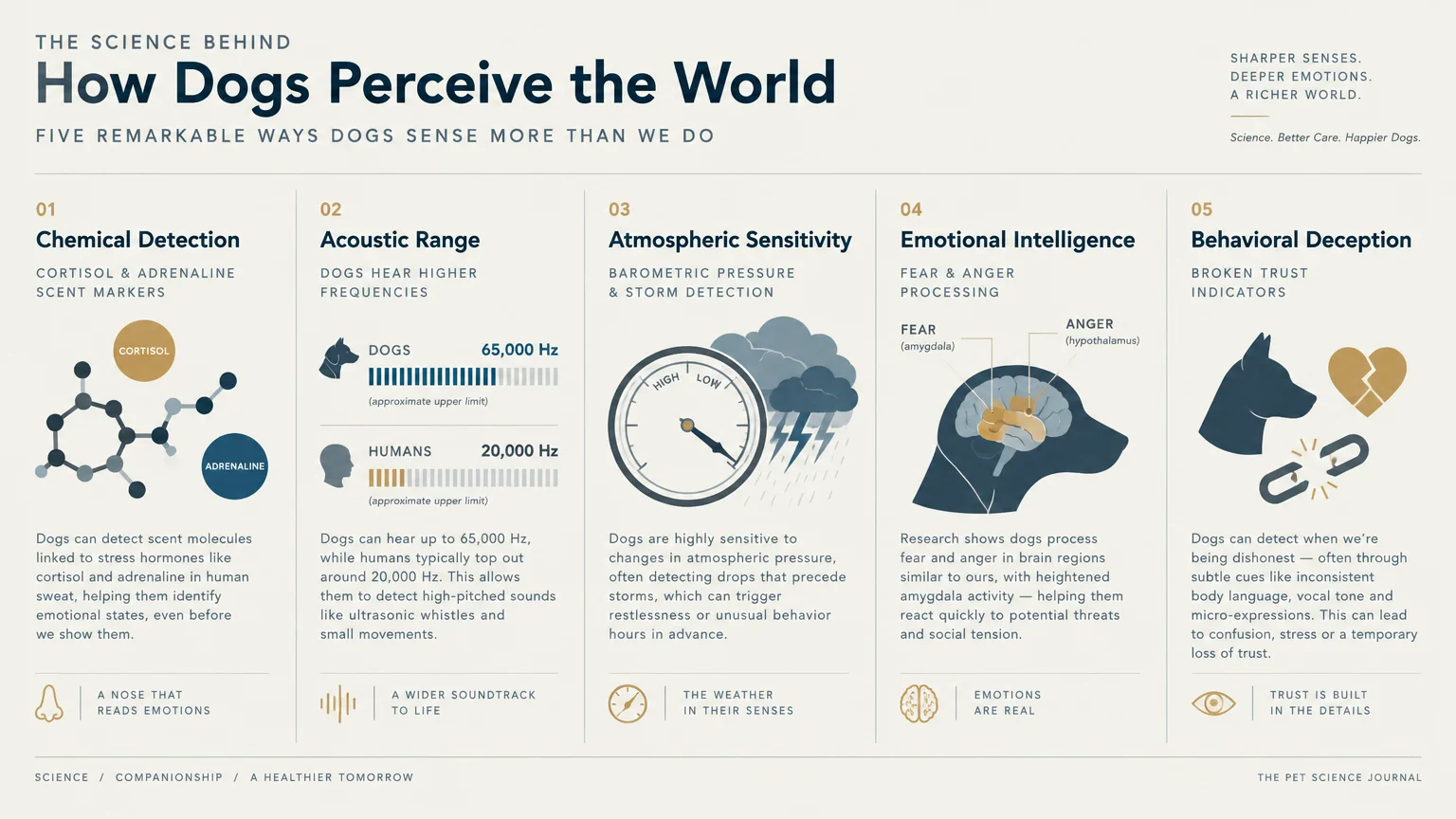
At a Glance: The Science of Canine Threat Detection
- Chemical Detection: Dogs smell human stress hormones like cortisol and adrenaline with astonishing precision.
- Acoustic Range: Dogs detect ultrasonic frequencies up to 65,000 Hz; human hearing caps at 20,000 Hz.
- Atmospheric Sensitivity: Canines register sudden barometric drops and static electricity hours before major storms hit.
- Emotional Intelligence: Brain scans demonstrate that dogs actively distinguish human fear, anger, and sadness from neutral expressions.
- Behavioral Deception: Research shows dogs quickly identify unreliable humans and stop trusting deceptive individuals.
Beyond the Myth of the Supernatural Sixth Sense
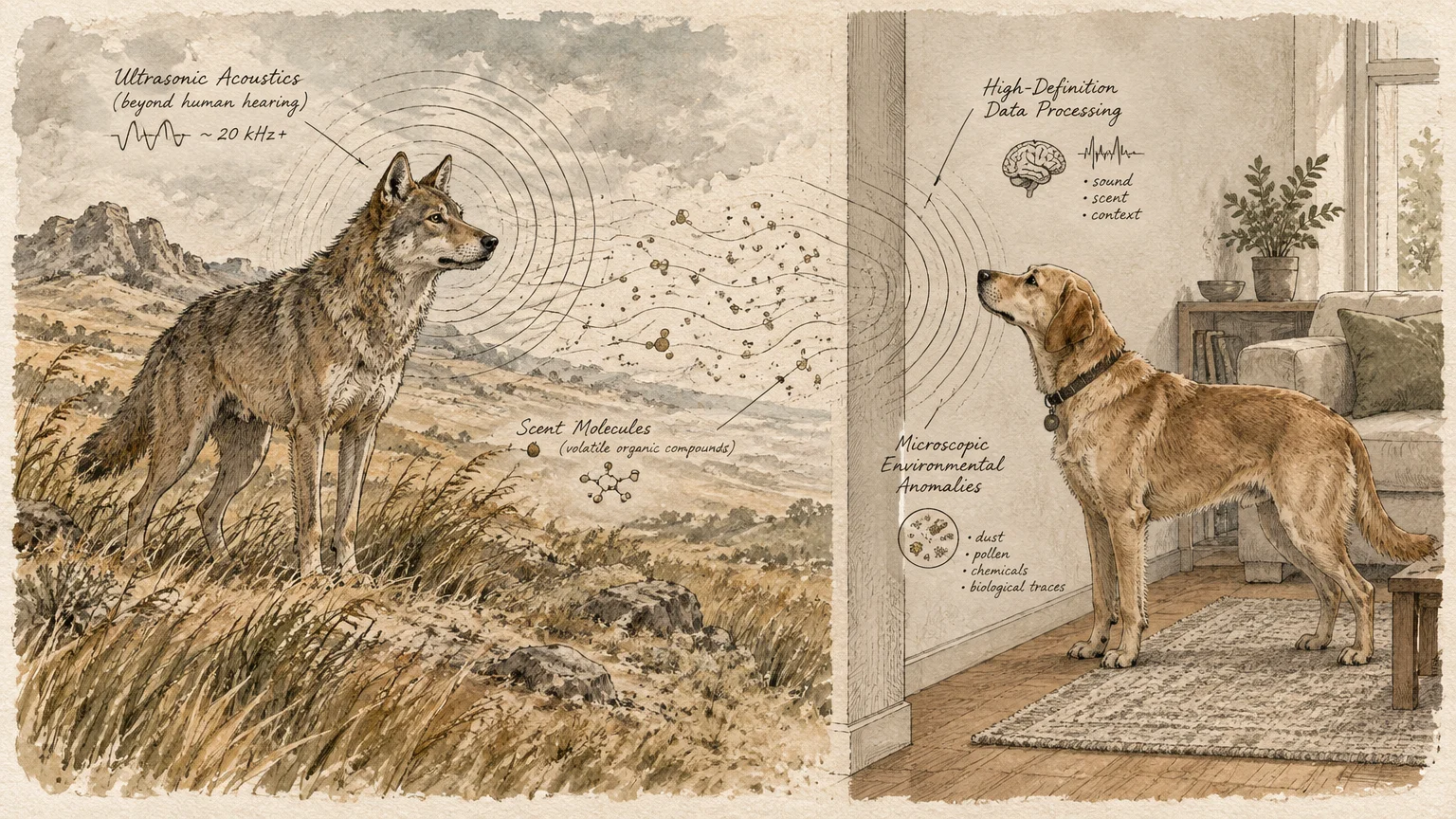
People often describe a dog’s sudden alert behavior as psychic intuition. You might watch your dog growl at an empty corner and wonder what supernatural presence triggered the reaction.
Wild canids relied on perpetual alertness to survive predators and hunt prey across unforgiving terrain. Natural selection rewarded dogs that detected microscopic environmental anomalies instantly.
Your dog does not possess magical foresight; instead, your dog possesses biological hardware that dwarfs human sensory limits. What feels like mysterious dog intuition to you is simply high-definition data processing to your pet.
Dogs cross-reference subtle acoustic frequencies, fleeting volatile organic compounds, and microscopic muscle twitches. When these inputs signal an anomaly, your dog reacts instantly to preserve personal and pack safety.
The Chemistry of Fear: How Dogs Smell Imminent Danger
Your dog’s nose functions as an extraordinarily complex chemical laboratory. While you navigate the world through vision, your dog experiences reality through an intricate landscape of volatile scents.
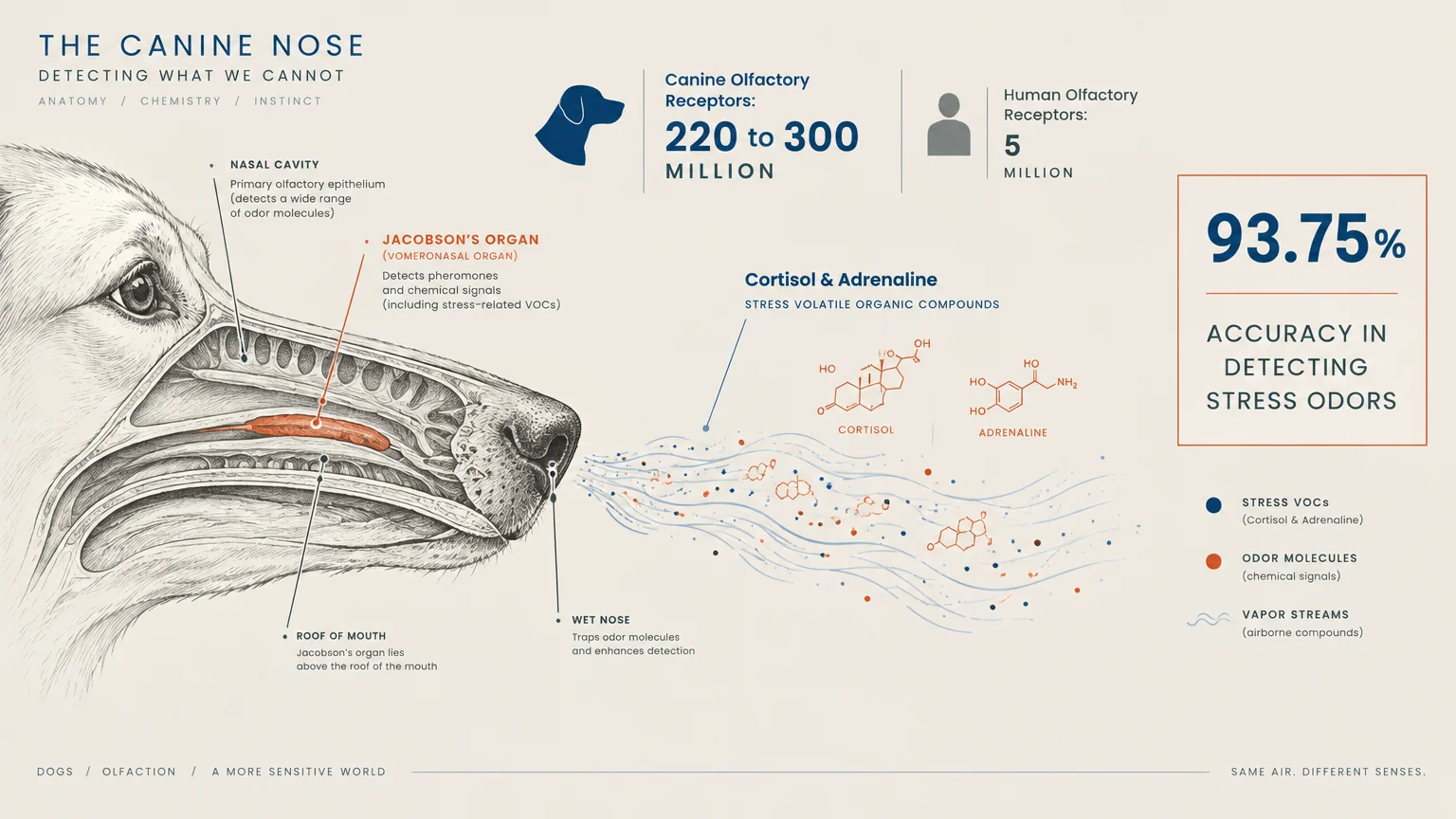
Dogs possess between 220 million and 300 million olfactory receptors inside their nasal cavities. Humans possess a modest 5 million scent receptors by comparison.
This immense biological disparity makes your dog’s sense of smell roughly 10,000 to 100,000 times more sensitive than your own. A dog can identify a single drop of a substance diluted across millions of gallons of water.
Dogs also possess the Jacobson’s organ, or vomeronasal organ, situated above the roof of the mouth. This specialized structure detects non-volatile chemical signals and mammalian pheromones that completely bypass human awareness.
When you feel terrified, your adrenal glands flood your bloodstream with adrenaline and cortisol. These hormones rapidly alter your perspiration, respiration rate, and the volatile organic compounds exiting your pores.
Research from PLOS One tested canine scent accuracy using sweat and breath samples from humans experiencing acute psychological stress. The dogs successfully detected human stress odors with 93.75% accuracy.
A landmark 2018 study from the University of Naples Federico II showed that dogs exposed to human fear sweat experienced elevated heart rates. The dogs demonstrated clear stress behaviors and sought immediate comfort from their owners.
A study published in Scientific Reports revealed that smelling stressed human breath and sweat causes emotional contagion in dogs. This stress odor made dogs noticeably more cautious and pessimistic when investigating their environment.
If an approaching stranger feels aggressive, malicious, or unnaturally anxious, that person emits an unmistakable chemical profile. Your dog detects this chemical shift in seconds and prepares to protect the home.
Acoustic Radar: Hearing Frequencies You Cannot Perceive
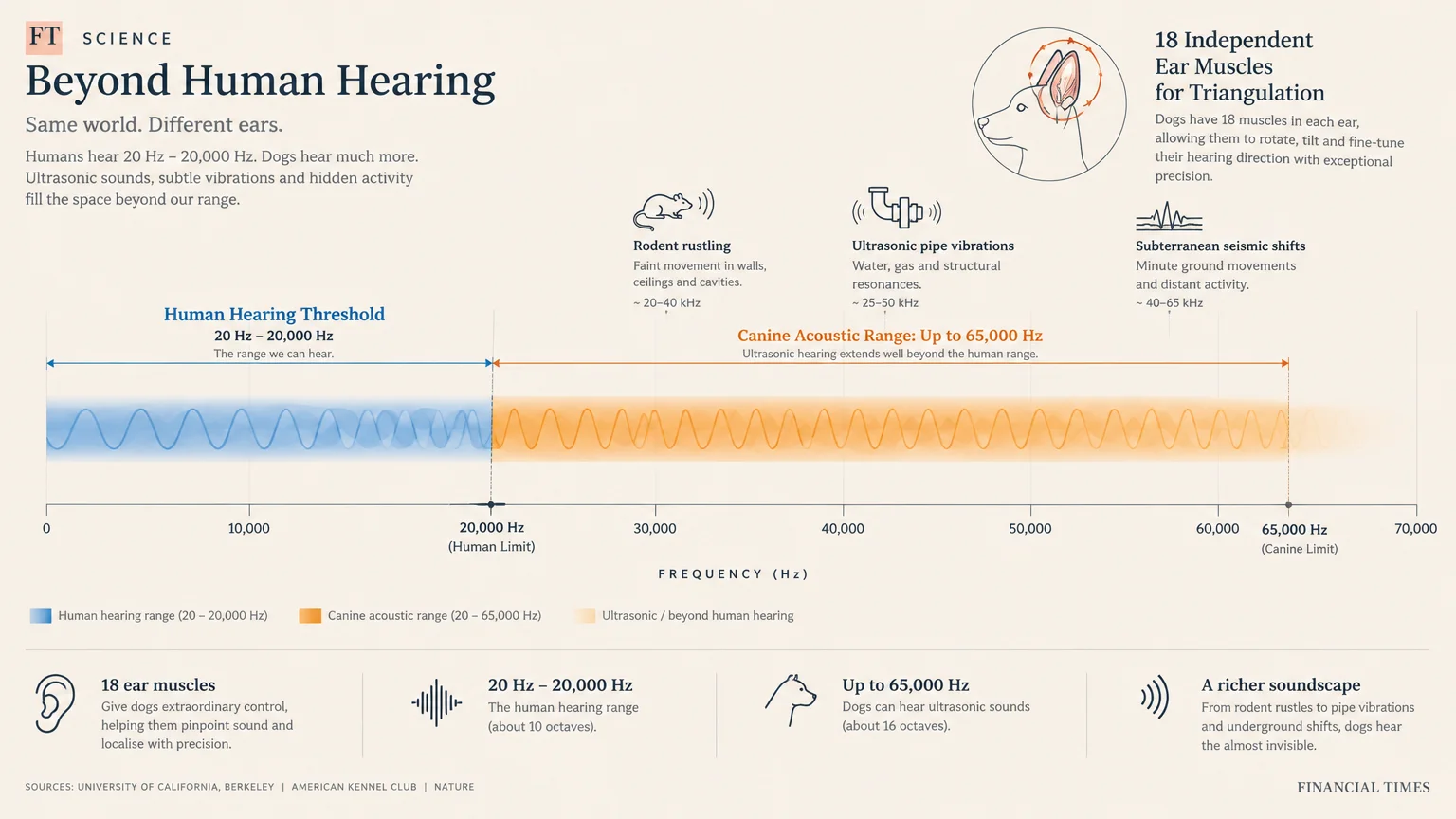
Sound often provides the earliest signal that an environmental threat approaches. While human hearing captures frequencies up to 20,000 Hz, canine hearing reaches up to 65,000 Hz.
This ultrasonic range allows dogs to detect the faint, high-pitched mechanical clicks of a malfunctioning electrical outlet inside your wall. Dogs can also hear the tiny scraping movements of pests or intruders outside your door.
Dogs control each ear independently using 18 distinct structural muscles. Your dog can rotate, tilt, and cup its ears toward a sound source to triangulate an exact location within split seconds.
Dogs also excel at detecting low-frequency infrasound vibrating through the earth. Before a tremor rattles your floorboards, subterranean rocks grind against each other and emit low-frequency acoustic waves.
Your dog perceives these vibrations through sensitive acoustic pathways and paw pads long before your vestibular system notices shaking. You might assume your dog panicked without cause when your pet actually heard the tremor approaching.

Atmospheric Shifts: Predicting Storms and Natural Disasters
Countless owners report that their dogs exhibit restless behavior hours before severe weather arrives. This behavior stems from clear physical triggers rather than superstitious foreknowledge.
Severe thunderstorms, tornadoes, and hurricanes produce dramatic drops in ambient barometric pressure. Canines detect these rapid changes in atmospheric pressure through their middle ears and sensitive sinus cavities.
Large storm fronts also build massive amounts of static electricity in the surrounding atmosphere. Dogs feel static electric charges collecting on their fur coats, which often produces an uncomfortable tingling sensation.
Incoming storm fronts ionize ambient air molecules, generating distinct ozone scents that travel miles ahead of visible rainclouds. Your dog smells this ionized air and immediately recognizes the chemical arrival of extreme weather.
Earthquakes generate two distinct vibrational waves through rock: high-frequency primary waves (P-waves) and slower secondary waves (S-waves). P-waves travel much faster than damaging S-waves, but humans rarely feel them.
Dogs hear and feel primary seismic waves arriving seconds to minutes ahead of the main destructive surface shocks. This rapid detection gives dogs an apparent predictive power during seismic catastrophes.
Reading Human Intent: How Dogs Spot Deceit and Aggression
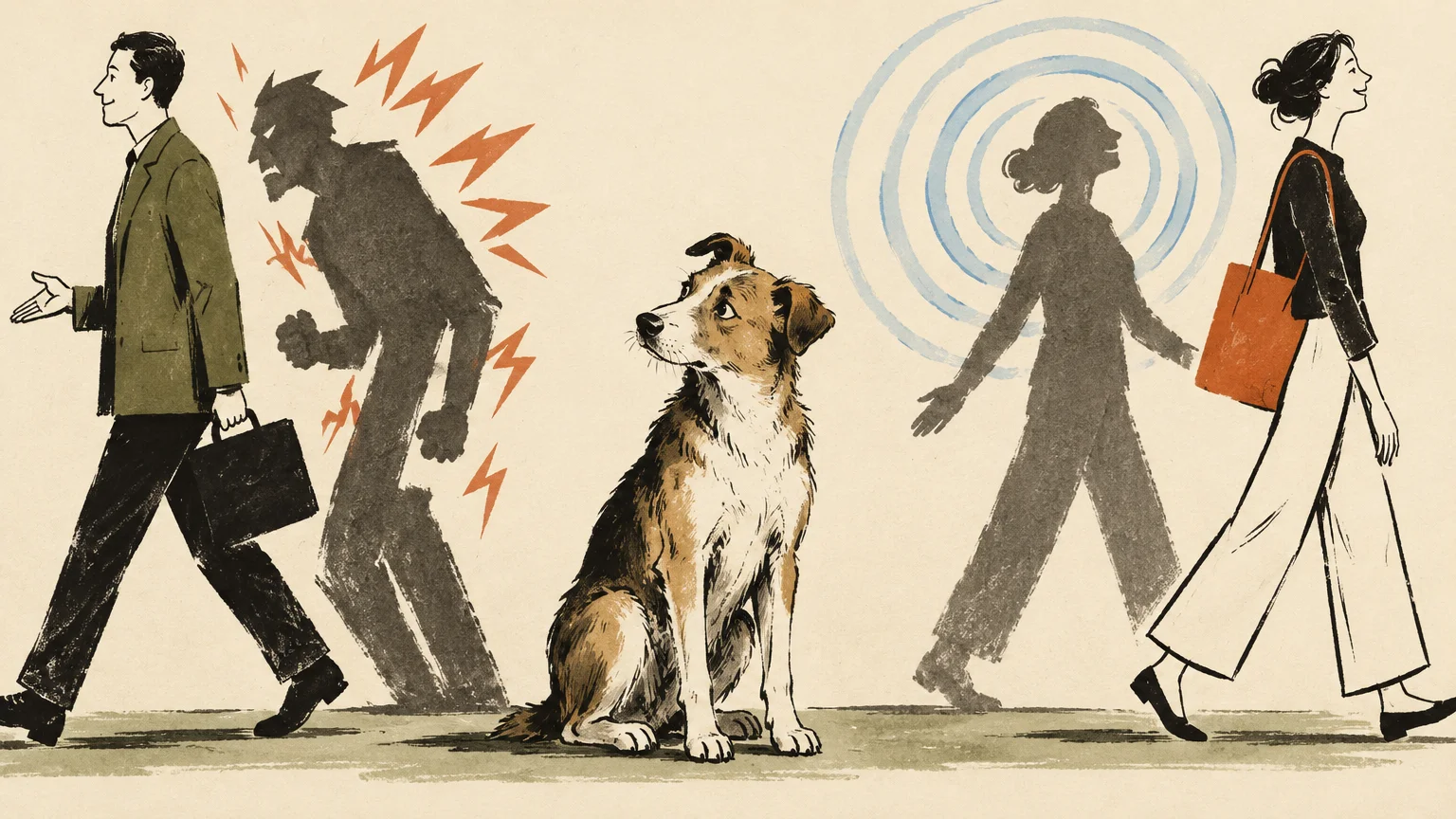
Dogs observe human micro-expressions and physical posture with forensic accuracy. Through thousands of years of domestication, canines evolved an unrivaled capacity to decode human social communication.
A study published in iScience utilized fMRI brain scans on awake dogs to investigate emotional processing. The data provided direct neurological proof that dogs actively differentiate human fear, anger, and sadness.
Your dog notices when a person’s physical posture conflicts with their verbal tone. If someone speaks with forced cheerfulness while locking their jaw and tensing their shoulder muscles, your dog notices the contradiction.
Dogs interpret rigid postures, prolonged direct staring, and forward-leaning stances as predatory warnings. When an individual displays these threatening physical markers, your dog instinctively raises an alarm.
A famous 2015 study from Kyoto University evaluated canine trust across 34 dogs. Experimenters pointed toward containers holding food before switching tactics and pointing toward empty containers.
After a human deliberately deceived the subjects, 100% of the 34 dogs refused to trust that person’s gestures on subsequent trials. Dogs swiftly evaluate human reliability and alter their cooperative behavior based on past deceit.
“Canine threat assessment is not supernatural intuition; it is the instantaneous synthesis of superior olfaction, ultrasonic hearing, and astute postural evaluation.”
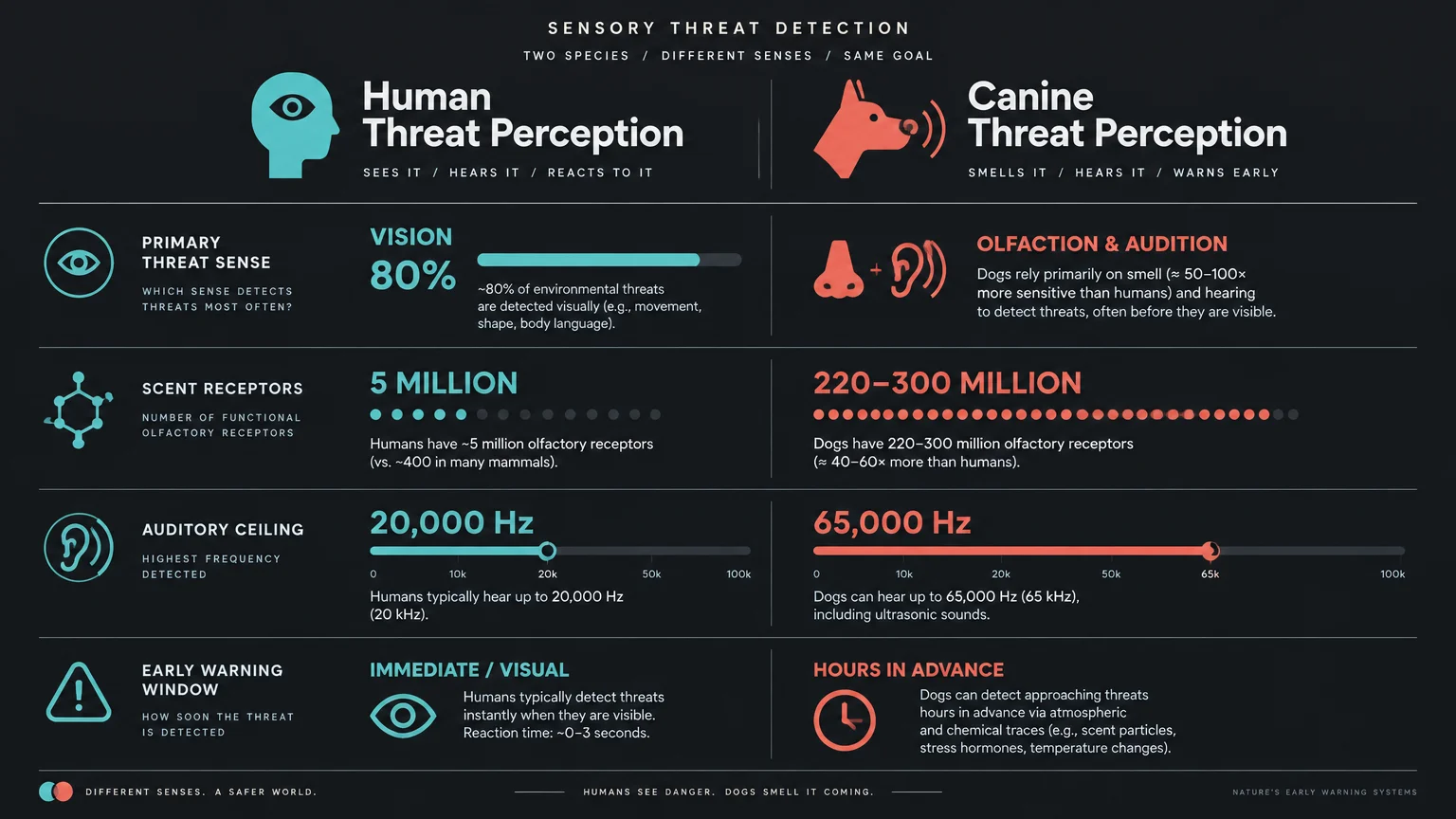
Canine vs. Human Threat Perception
Evaluating the differences between canine and human senses clarifies why your dog senses danger first. The following comparison highlights key physiological differences.
| Sensory Attribute | Canine Capability | Human Capability | Threat Detection Benefit |
|---|---|---|---|
| Olfactory Receptors | 220 to 300 million | Roughly 5 million | Detects hormonal stress surges, smoke, gas, and illness instantly. |
| Upper Hearing Range | 45,000 to 65,000 Hz | Roughly 20,000 Hz | Identifies ultrasonic friction, electrical faults, and distant movements. |
| Ear Mobility | 18 independent muscles per ear | Rudimentary, immobile muscles | Pinpoints exact physical coordinates of unexpected acoustic anomalies. |
| Vomeronasal Organ | Fully functional (Jacobson’s) | Vestigial and non-functional | Decodes defensive pheromones, fear emissions, and social cues. |
| Barometric Sensitivity | High sinus and inner-ear sensitivity | Low atmospheric sensitivity | Anticipates severe storms, tornadoes, and pressure swings hours early. |
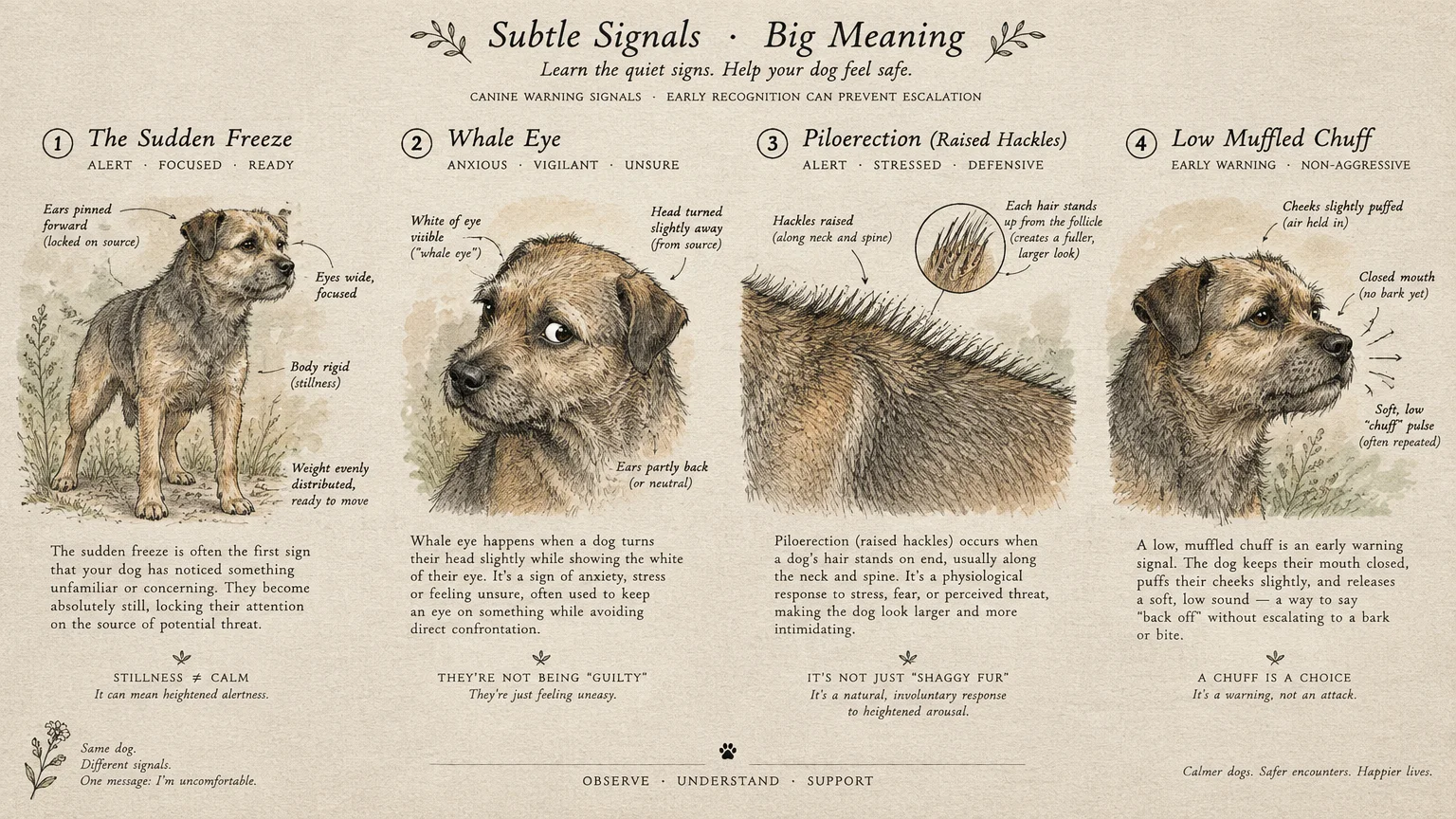
Canine Alarm Cues: How Your Dog Warns You
Dogs use a distinct vocabulary of physical postures and sounds when alerting to potential danger. Learning these signals helps you distinguish between playful excitement and genuine protective concern.
The freeze response represents one of the most reliable canine alert markers. If your dog abruptly stops walking, stiffens its spine, and stares fixatedly in one direction, your pet detected an anomaly.
Piloerection, commonly called raised hackles, occurs when the hair along your dog’s neck, spine, and tail stands upright. An involuntary adrenaline rush triggers the arrector pili muscles to raise the coat.
Dogs also exhibit subtle stress signals known as displacement behaviors before escalating into defensive displays. Rapid lip licking, exaggerated yawning, and displaying the whites of their eyes—known as whale eye—indicate rising discomfort.
A danger alert vocalization sounds distinctly different from a joyful greeting bark. Threat barks often feature a lower, resonant pitch, frequently interspersed with sharp pauses and muffled throat rumbles.
Many companion dogs position their bodies deliberately between their handler and an approaching threat. This blocking behavior reflects an instinctual attempt to shield pack members from unexpected danger.

Common Mistakes to Avoid When Interpreting Dog Behavior
While dogs possess remarkable sensory systems, owners frequently misinterpret normal canine anxiety as genuine danger detection. Avoiding these common behavioral assumptions keeps interactions balanced and safe.
Do not assume someone is an evil person simply because your dog barks at them. Dogs frequently react with fear toward novel appearances, including hats, bulky coats, facial hair, or unusual walking gaits.
Never punish your dog for growling or barking during an alert state. Punishing an early warning cue suppresses valuable communication and can cause a dog to bite without warning later.
Avoid mistaking poor socialization for protective intuition. A poorly socialized dog reacts out of generalized fear and nervous reactivity rather than genuine threat identification.
Do not feed into your dog’s sudden panic during severe thunderstorms or unexpected alerts. Your dog reads your elevated heart rate and tense posture, escalating its own distress through emotional contagion.
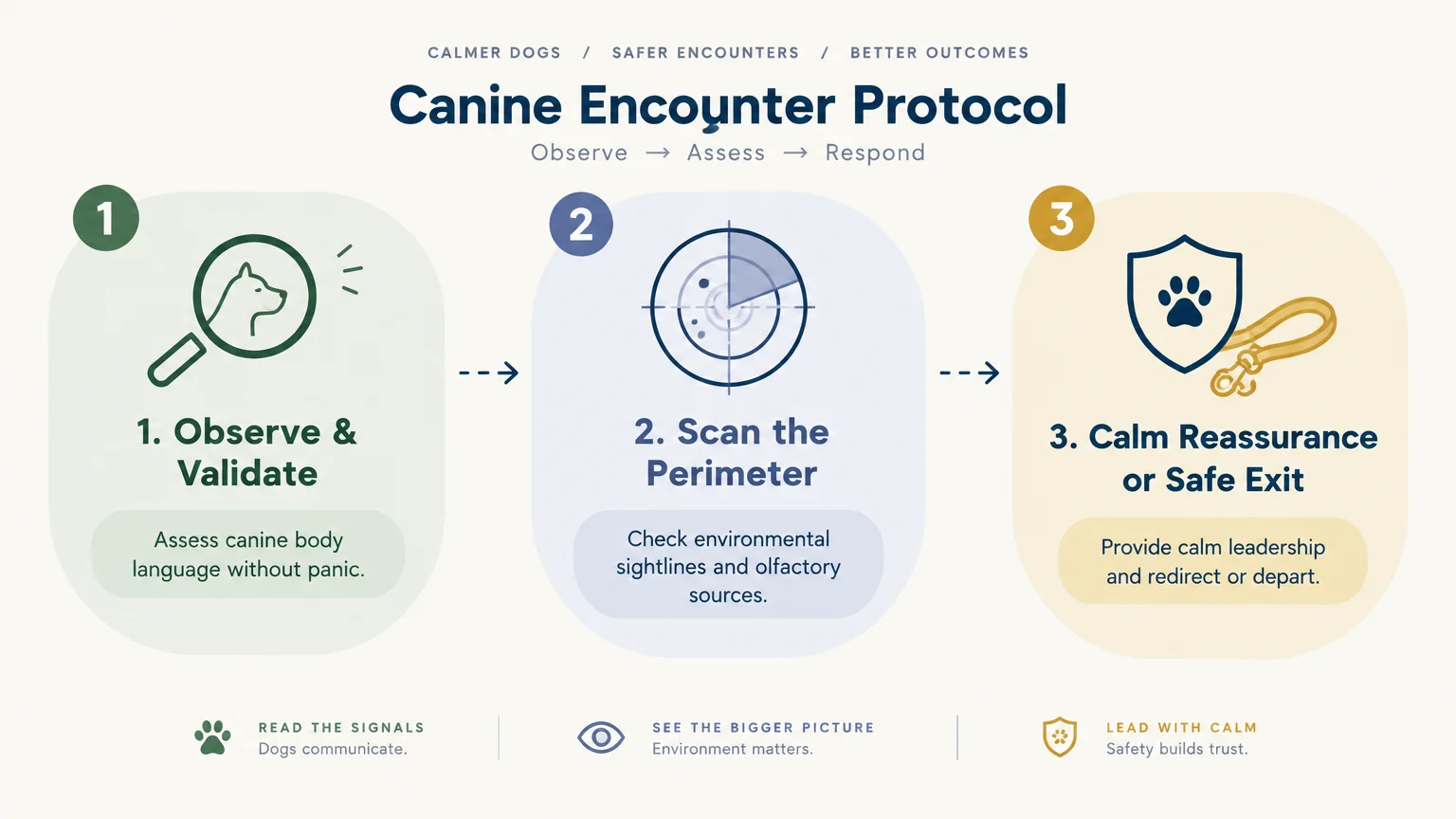
Actionable Protocol: What to Do When Your Dog Alerts
When your dog signals distress or alerts to an unseen presence, respond methodically. Follow these straightforward steps to evaluate your surroundings while maintaining canine focus.
- Evaluate your physical environment: Look and listen carefully for environmental hazards like gas leaks, electrical sparking, smoke, or approaching strangers.
- Control your personal physiology: Take slow, deliberate breaths to lower your own heart rate, preventing stress odor transmission to your dog.
- Acknowledge the alert neutrally: Check the source of your dog’s interest calmly so your dog knows you evaluated the stimulus.
- Redirect canine focus: Issue a familiar obedience command, such as a sit-stay or heel, to ground your dog in structured behavior.
- Reward calm behavior: Offer high-value treats once your dog relaxes its posture and disengages from the perceived threat.
Frequently Asked Questions About Canine Danger Detection
Can dogs smell adrenaline and cortisol directly?
Dogs do not smell pure hormones circulating inside your veins. They detect volatile organic compounds and distinct metabolic byproducts released through your breath and sweat when hormones surge.
Can dogs predict an earthquake hours in advance?
Science does not support claims that dogs predict quakes hours early. Dogs reliably detect fast-moving acoustic P-waves and ground micro-vibrations seconds to minutes before noticeable surface shaking occurs.
Why does my dog bark at friendly guests but ignore strangers?
Dogs react strongly to unfamiliar movement patterns, strong synthetic perfumes, or nervous human body language. A friendly visitor carrying tension or wearing unfamiliar accessories can easily trigger an alert reaction.
Do all dog breeds detect danger with equal accuracy?
All healthy dogs possess superior senses compared to humans, but breed traits influence responsiveness. Scent hounds, pastoral guard breeds, and working terriers exhibit different sensory thresholds and alert patterns.
Respecting the Power of Canine Senses
Your dog lives in a rich sensory landscape of microscopic scents, ultrasonic acoustic frequencies, and invisible atmospheric shifts. What often appears to be psychic intuition is the result of extraordinary biological adaptation.
By learning to read your dog’s alert cues and understanding their sensory triggers, you strengthen your communication with your companion. Pay attention when your dog pauses, investigates the air, and listens to the quiet world around you.
This is general informational content based on widely accepted guidance. Individual results vary.
Verify current details—rules, prices, eligibility, regulations—with official sources before making important decisions.
Last updated: October 2026. Rules, prices, and details change—verify current information with official sources before acting on it.