
Look around your neighborhood dog park, and you will quickly notice that favorite breeds depend heavily on your zip code. A sturdy retriever might rule snowy mountain towns, while toy breeds dominate crowded city sidewalks.
Recent state-by-state data reveals dramatic regional shifts in what Americans actually bring home. Even long-reigning national champions lose their crown once you zoom in on local households.
Whether you share your couch with a purebred French Bulldog or a loyal mixed-breed rescue, seeing where your dog ranks helps you understand local trends, care costs, and breed health.

At a Glance
- State Leaders Differ From National Charts: While the French Bulldog tops purebred registrations nationwide, the Labrador Retriever leads 22 states in pet insurance data, followed by the Chihuahua in 13 states.
- Small Dogs Rule Populous States: Breeds like the Chihuahua, Yorkshire Terrier, French Bulldog, and Shih Tzu hold the top spot across states representing roughly two-thirds of the U.S. population.
- Mixed Breeds Win Real-World Homes: Pet-care profile data places non-designer mixed breeds ahead of every purebred dog in American households.
- Official State Dogs Tell Local History: Only 13 states name a specific breed by law, while four recognize broader categories such as rescue or working dogs.
How Popular Dog Breeds Break Down Across All 50 States
Pinpointing the most popular dog breed by state depends on how researchers count dogs. An October 2026 analysis by U.S. News & World Report and Visual Capitalist offers the clearest geographic snapshot.
Researchers examined 3.5 million pet insurance data points collected between January 2022 and June 2026 across all 50 states and Washington, D.C. That massive dataset shows stark divides between rural regions and dense coastal metros.
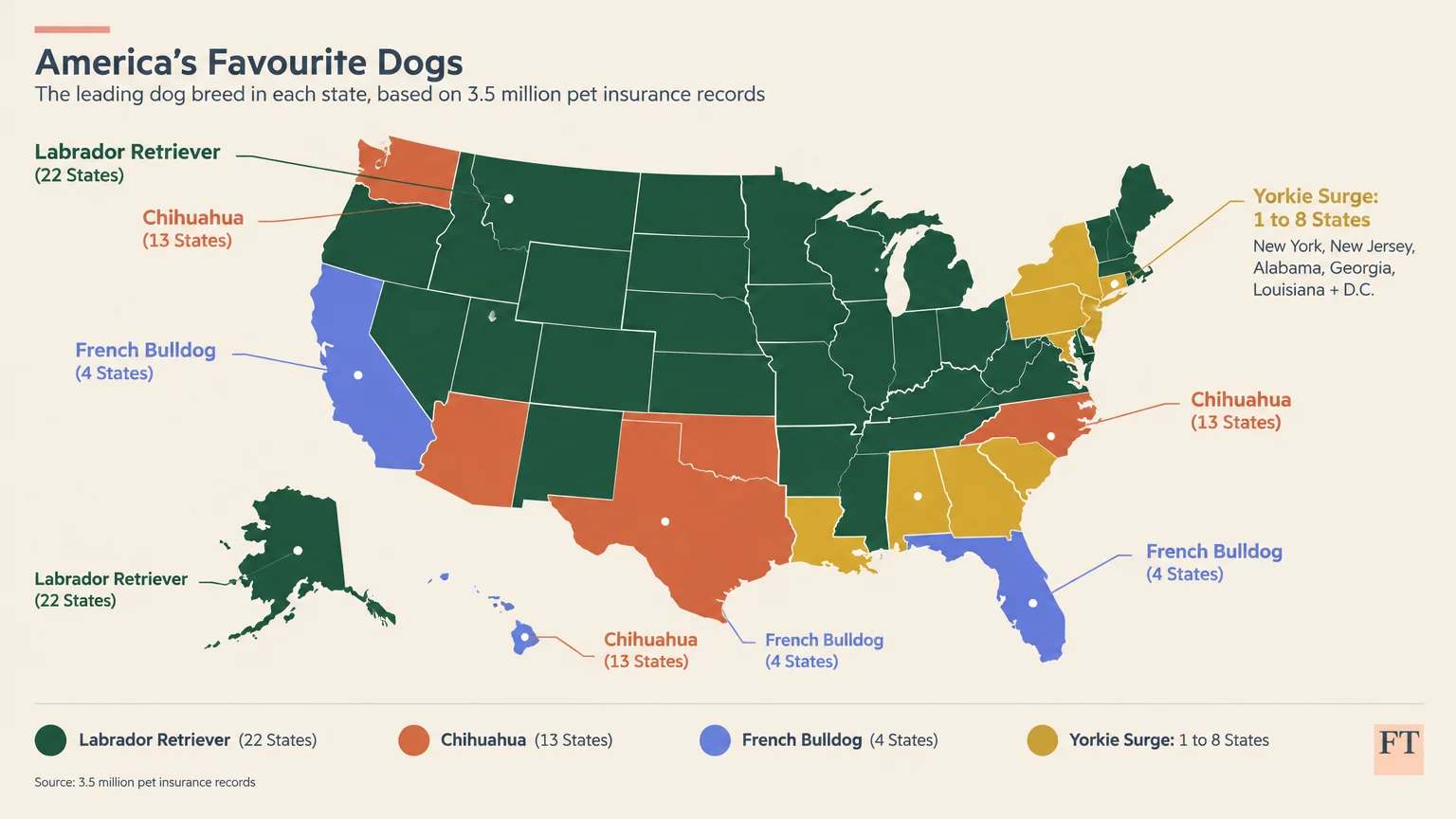
The Labrador Retriever claims the #1 spot in 22 states, making it the widest geographic leader in the country. Labs dominate across Alaska, the Mountain West, the Midwest, and New England, even though they rank #3 in the overall pooled dataset.
Meanwhile, the Chihuahua takes first place in 13 states, outranking every other small breed in geographic reach. You will spot Chihuahuas leading households across Texas, Arizona, Oklahoma, North Carolina, and Washington.
The biggest upward mover in the 2026 state rankings is the Yorkshire Terrier. Yorkies leaped from just one state in 2025—New York—to eight states plus Washington, D.C. in 2026.
That surge pushed the Yorkshire Terrier from #9 to #4 nationally within the insurance dataset. Yorkies now hold #1 in Alabama, Georgia, Louisiana, Mississippi, Indiana, Maryland, New Jersey, and New York.
The French Bulldog, despite holding the top national purebred title, leads in only four states. Those Frenchie strongholds include California, Florida, and Hawaii, where apartment living and mild or indoor-focused lifestyles suit compact companions.
Notice a clear pattern among America’s largest population centers. Small breeds lead all four of the most populous states: California, Texas, Florida, and New York.
In fact, states led by the Chihuahua, Yorkshire Terrier, French Bulldog, or Shih Tzu account for roughly two-thirds of the entire U.S. population. Urban density, rental size limits, and travel convenience push many city residents toward dogs under 20 pounds.
State preferences also shift faster than you might expect. Between 2025 and 2026, 24 states and Washington, D.C. flipped their #1 insured breed.
In 2025, American Pit Bull Terriers led seven states, and German Shepherds shared 11 states when combined with Pit Bulls. By 2026, both breeds dropped to zero state leads in the insurance dataset.
State-by-State Breakdown and Regional Favorites
Because different breeds cluster in distinct parts of the country, looking at dog breeds by state shows how climate and housing shape pet ownership. Use the table below to see where the leading insured breeds dominate.
| Leading Breed | States Led (2026 Data) | Confirmed Strongholds | Key 2025–2026 Trend |
|---|---|---|---|
| Labrador Retriever | 22 states | Alaska, Mountain West, Midwest, New England | Broadest geographic lead; #3 in pooled national dataset |
| Chihuahua | 13 states | Texas, Arizona, Oklahoma, North Carolina, Washington | Top small breed by total state count |
| Yorkshire Terrier | 8 states plus D.C. | Alabama, Georgia, Louisiana, Mississippi, Indiana, Maryland, New Jersey, New York, D.C. | Jumped from 1 state (NY) in 2025; rose #9 to #4 nationally |
| French Bulldog | 4 states | California, Florida, Hawaii (plus 1 additional state) | Leads high-population coastal and island states |
| Shih Tzu and Other Small Leads | Remaining 3 states | Contributes to two-thirds population share with small-breed states | Reflects steady urban demand for compact companions |
Even within a single state, city neighborhoods often break away from regional norms. City-level registration updates released by the American Kennel Club (AKC) in March 2026 highlight sharp local contrasts.
In Albany, New York, for example, the Poodle took #1 in purebred registrations while the French Bulldog sat at #5. Jump south to Atlanta, Georgia, and the French Bulldog claimed #1 ahead of both Golden Retrievers and Labrador Retrievers.
These city splits prove that statewide winners do not tell the whole story for your neighborhood. Suburbs with fenced yards favor sporting breeds, whereas downtown corridors lean toward toy and non-sporting companions.
Why National Dog Rankings Tell a Very Different Story
If your dog is not leading a state chart, you might still own one of the most popular dog breeds in the USA. National rankings vary wildly depending on whether a list tracks purebred registrations, sitter profiles, or public polling.
Consider the official AKC rankings covering 2025 purebred registrations, released on March 18, 2026. For the fourth year in a row, the French Bulldog took #1 across America.
That run marks a huge turnaround from 2012, when the French Bulldog sat at #14. The breed climbed to #2 in 2021 before ending the Labrador Retriever’s 31-year streak at #1 in 2022.
Here is the full AKC top 10 purebred list from the 2025 registration year:
- French Bulldog: Holds #1 for the fourth straight year due to compact size and calm indoor habits.
- Labrador Retriever: Remains America’s favorite sporting dog and top state-level leader.
- Golden Retriever: Prized by families for steady temperament and trainability.
- German Shepherd Dog: Valued for loyalty, intelligence, and working versatility.
- Dachshund: Entered the top five for the first time since 2003, nudging the Poodle down a spot.
- Poodle: Popular across toy, miniature, and standard sizes for low-shedding coats.
- Beagle: Remains a staple scent hound for active families.
- Rottweiler: Continues strong demand among experienced large-breed owners.
- German Shorthaired Pointer: Favored by runners, hikers, and outdoor enthusiasts.
- Bulldog: Rounds out the top 10, just ahead of the rising Cane Corso at #11.
At the bottom of that 202-breed purebred list sits the Norwegian Lundehund at #202. Meanwhile, the AKC expanded its roster to 205 recognized breeds on January 1, 2026.
The three newest additions are the Basset Fauve de Bretagne, the Russian Tsvetnaya Bolonka, and the Teddy Roosevelt Terrier. A year earlier, the Danish-Swedish Farmdog joined in January 2025 and debuted at #170.
However, AKC rankings leave out huge segments of America’s favorite dog breeds. Purebred registration lists do not count mixed-breed dogs, unregistered purebreds, or designer crossbreeds such as doodles.
To see what everyday owners actually walk down the street, look at 2026 profile data from Rover across millions of U.S. pets. Non-designer mixed breeds rank #1 overall in real-world households.
Behind mixed breeds, Rover’s top five features the Labrador Retriever at #2, Golden Retriever at #3, Goldendoodle at #4, and German Shepherd at #5. Labradoodles sit at #13, and Bernedoodles hold #15.
Pop culture even nudges real-world breed popularity. The Australian Cattle Dog cracked Rover’s top 20 at #19 in 2026, helped in part by the animated series Bluey.
Looking at year-over-year profile growth reveals which breeds are gaining momentum fastest in 2026:
- Pomsky (+13%): Leads all trending breeds as owners seek husky looks in a smaller package.
- Toy Poodle (+7%): Grows rapidly among apartment dwellers wanting low-shedding companions.
- Bernedoodle (+7%): Continues rising alongside steady demand for gentle family crossbreeds.
- Miniature Poodle (+6%): Appeals to owners balancing medium energy with manageable size.
- Dachshund (+6%): Mirrors its jump into the AKC top five.
Admiration does not always match ownership, either. In Q3 2026 national opinion polling by YouGov, the Golden Retriever earned the highest positive rating in America at 82% popularity and 97% name recognition.
YouGov’s top five most liked breeds also included the German Shepherd (79%), Collie (74%), Alaskan Husky (74%), and Labrador Retriever (73%). Many people adore big, energetic working dogs from afar even when their schedules fit smaller breeds better.

Official U.S. State Dog Breeds: History Written Into Law
Popular demand changes every few years, but state legislatures occasionally lock a breed into law. Back in 1964, Maryland became the first state to adopt an official dog by naming the Chesapeake Bay Retriever.
Today, 13 states designate a specific breed as an official state symbol. Most choices honor working dogs bred for local hunting, herding, or harsh winter climates.
| State | Official State Dog | Year Adopted | Historical Role |
|---|---|---|---|
| Maryland | Chesapeake Bay Retriever | 1964 | Waterfowl retriever built for icy Chesapeake Bay waters |
| Pennsylvania | Great Dane | 1965 | Honored as a powerful working guardian and estate dog |
| Virginia | American Foxhound | 1966 | Tied to colonial-era scent hunting traditions |
| Louisiana | Catahoula Leopard Dog | 1979 | Rugged herding and hunting dog native to northern Louisiana |
| Massachusetts | Boston Terrier | 1979 | First U.S.-developed companion breed, created in Boston |
| South Carolina | Boykin Spaniel | 1985 | Compact retriever bred for Wateree River swamps |
| Wisconsin | American Water Spaniel | 1985 | Developed in the Fox River Valley for boat-based retrieving |
| North Carolina | Plott Hound | 1989 | Mountain scent hound bred in the Great Smoky Mountains |
| Texas | Blue Lacy | 2005 | Fast, tough ranch dog developed by the Lacy family |
| New Hampshire | Chinook | 2009 | Rare sled dog developed in New Hampshire |
| Alaska | Alaskan Malamute | 2010 | Heavy-freight Arctic sled dog vital to northern history |
| Tennessee | Bluetick Coonhound | 2019 | Famous for trailing ability and deep ties to state athletics |
| Connecticut | Siberian Husky | 2024 | Became official October 1, 2024, honoring the UConn mascot |
Four additional states passed laws honoring a broader category of dog rather than picking one breed. New York named the working dog in 2015, and Georgia recognized the adoptable dog in 2016.
New Jersey designated the Seeing-Eye dog in 2019 to honor guide-dog training roots in the state. Delaware shifted from the Golden Retriever—its state dog from 2016 to 2022—to the rescue dog in 2023.
What It Costs to Own a Favorite Breed Where You Live
Dog ownership across the United States continues to grow despite rising veterinary and supply prices. According to the 2026 American Veterinary Medical Association (AVMA) Pet Ownership and Demographics Sourcebook, 58.9 million U.S. households—or 43.7%—own a dog in 2026.
That household count climbed from 56.3 million in 2025, bringing the total U.S. pet dog population to 88.9 million. Dog-owning homes average 1.6 dogs per household based on 2025 AVMA tracking.
Using a broader survey approach, the American Pet Products Association estimates 71 million households—about 53%—owned a dog in 2025. Total U.S. pet industry spending reached $158 billion in 2025 and is projected to hit $165 billion in 2026.
Your state’s cost of living directly affects how much you spend keeping a favorite breed healthy. September 2026 figures from Forbes Advisor place essential annual dog expenses at an average of $1,533 per year.
When you factor in broader routine and unexpected care, Pawlicy Advisor reports total annual pet-care spending near $2,500 per year. Location creates roughly a $1,300 annual gap between states.
Dog owners face the steepest yearly bills in Alaska and Hawaii, averaging roughly $3,500 per year. By comparison, owners in Alabama and Arkansas spend closer to $2,200 annually.
Larger breeds like Labrador Retrievers and German Shepherds also cost more to feed and medicate than toy breeds. Dosage-based heartworm preventives, joint supplements, and surgical anesthesia scale upward with body weight.

Worth Keeping in Mind
Popularity charts make fun conversation at the dog park, yet chasing a trending breed without reading the fine print creates real headaches. Keep four practical caveats in mind before using any ranking to pick your next pet.
- Insurance Data Skews Toward Certain Owners: The 50-state study covers 3.5 million pet insurance data points rather than a census of every dog. Owners of expensive purebreds or high-cost urban pets buy policies more often than rural owners of mixed breeds.
- High Rankings Do Not Equal Easy Care: As the AKC emphasizes, registration volume measures demand rather than lifestyle compatibility. A #4 German Shepherd needs intensive daily training and mental work that overwhelms many busy households.
- Flat-Faced Breeds Carry Serious Health Risks: With French Bulldogs at #1 and Bulldogs at #10 on AKC charts, the AVMA intensified its welfare focus on brachycephalic dogs in 2025. Dogs with skull widths at least 80% of their length face higher risks of Brachycephalic Obstructive Airway Syndrome, heat intolerance, and spinal issues.
- Millions of Shelter Dogs Still Wait for Homes: National data from Shelter Animals Count shows roughly 2.8 million dogs entered U.S. shelters and rescues in 2025, with about 2.0 million adopted. In the first half of 2026, adoptions reached 1.1 million—72,000 fewer than the same period in 2016—leaving 236,000 adult dogs, or 66% of dogs in care, waiting for families.
How to Choose the Right Breed for Your Home and Climate
Instead of picking whatever breed tops your state map, match a dog’s biology and daily habits to your actual routine. Follow these five steps before committing to a breeder or rescue.
- Audit Your Living Space and Local Weather: Heavy-coated Arctic breeds struggle in humid southern summers, whereas thin-coated Chihuahuas need sweaters during northern winters. Check apartment weight limits and breed restrictions on your lease or homeowners insurance first.
- Calculate Honest Exercise Hours: Sporting and herding breeds like Labradors and Australian Cattle Dogs require vigorous daily outlets. If your routine favors short neighborhood strolls, companion breeds or calm adult rescues fit far better.
- Demand Verified Health Screenings: Look for breeding dogs with CHIC Certification through the Orthopedic Foundation for Animals (OFA), which confirms testing for every condition recommended by the breed’s national club. For French Bulldogs, Bulldogs, and Pugs, ask for results from the University of Cambridge Respiratory Function Grading Scheme licensed by the OFA.
- Budget for State-Specific Care Costs: Price out local veterinary exams, parasite prevention, grooming, and emergency savings before bringing a puppy home. Remember that grooming bills for doodles and Poodles add substantial recurring costs every six to eight weeks.
- Meet Adult Shelter Dogs Locally: Visit municipal shelters and breed-specific rescues in your state to meet dogs whose adult size and temperament are already clear. Staff can match you with mixed breeds or purebreds suited to your household energy.

When to Get Professional Help
Even well-researched dog owners benefit from expert guidance before and after bringing a pet home. Reach out to qualified professionals in these specific situations.
- Before Buying a Flat-Faced or Giant Breed: Ask a veterinarian to explain breed-specific airway, joint, or spinal risks and review OFA health clearances with you before putting down a deposit.
- When Mapping Out Medical and Insurance Budgets: Consult your local veterinary clinic for realistic regional pricing on vaccines, spay or neuter surgery, and chronic condition care in your state.
- If Energy or Behavior Mismatches Appear: Work with a certified dog trainer or veterinary behaviorist early if herding, guarding, or separation habits strain your daily routine.
- Before Signing Contracts or Breed-Restricted Leases: Have a qualified professional review landlord addendums, homeowners insurance exclusions, or breeder health guarantees if terms look unclear.
Frequently Asked Questions About Popular Dog Breeds
What is the #1 most popular dog breed in the United States right now?
The French Bulldog ranks #1 among purebred registrations in 2025 AKC data released in March 2026, marking its fourth consecutive year on top. However, Rover’s 2026 profile data shows non-designer mixed breeds outnumber every purebred in U.S. homes.
Which dog breed leads the most states?
In the October 2026 state-by-state pet insurance analysis of 3.5 million records, the Labrador Retriever ranked #1 in 22 states. The Chihuahua ranked second geographically, leading 13 states across the South, Southwest, and Pacific Northwest.
Why do mixed breeds rarely appear on official state or AKC lists?
The AKC tracks only registered purebred dogs across its 205 recognized breeds, excluding mixed breeds and designer crossbreeds like Goldendoodles. Insurance studies often separate crossbreeds or log specific parent breeds, keeping mixed dogs off single-breed charts.
Does every state have an official state dog?
No—only 17 states recognize an official state dog by law. Thirteen designate a specific breed, from Maryland’s Chesapeake Bay Retriever in 1964 to Connecticut’s Siberian Husky in 2024, while four honor categories like rescue or working dogs.
Your Next Step as a Dog Lover
Whether your dog reigns as a state favorite, sits in the AKC top 10, or charms your block as a one-of-a-kind mix, local popularity is only a starting point. Prioritizing verified health screenings, realistic regional budgets, and daily enrichment keeps any breed thriving beside you.
This article provides general information only. Every reader’s situation is different—what works for others may not be the right fit for you.
For personalized guidance on health, legal, or financial matters, consult a qualified professional.
Last updated: November 2026. Rules, prices, and details change—verify current information with official sources before acting on it.